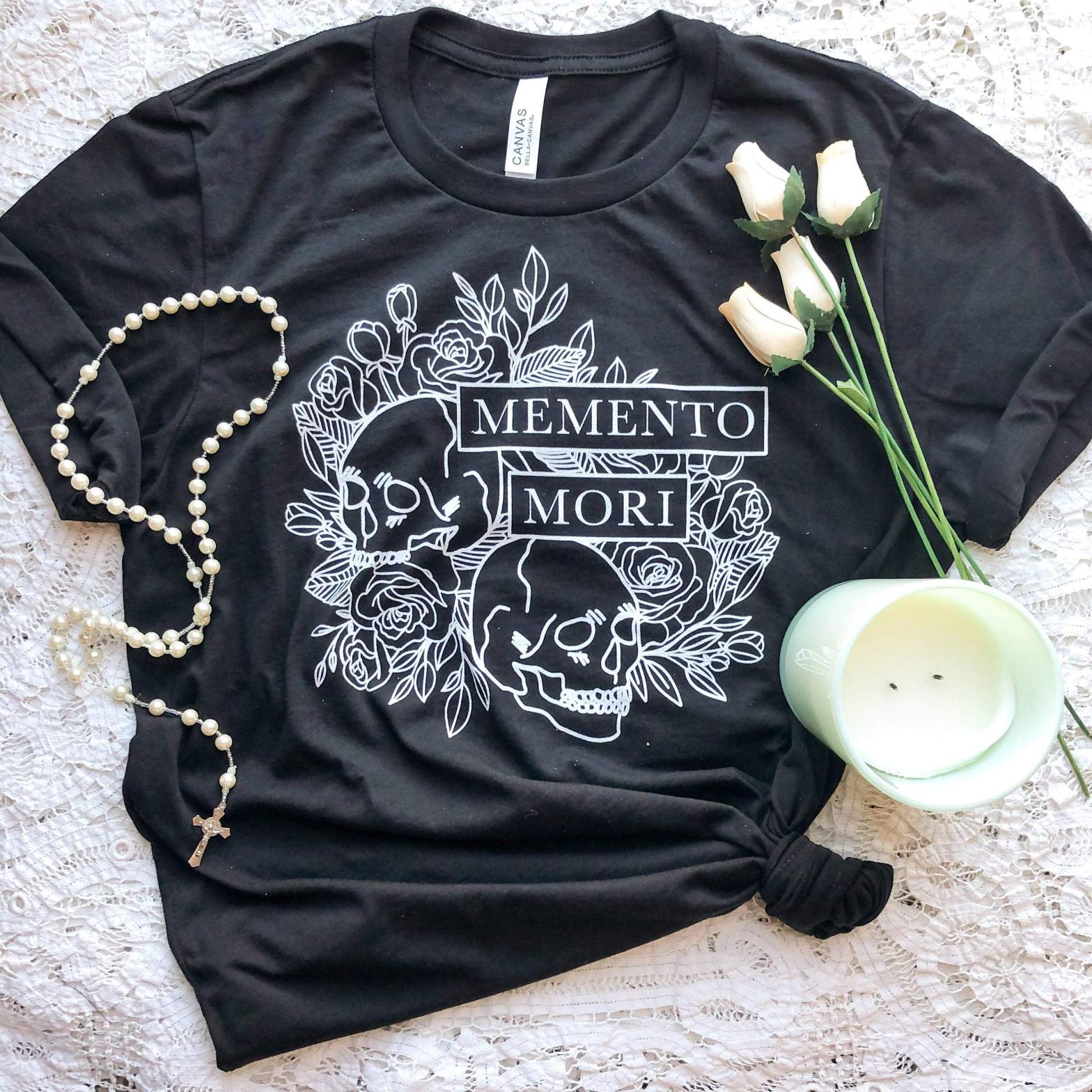
This sermon was given on the occasion of Ash Wednesday 2025, and primarily addresses the liturgy of the day as well as several references to the Burial Office, both of which can be found in the Book of Common Prayer! The t-shirt mentioned is a discontinued product of The Little Rose Shop, but a similar design is available on their online store, pictured above.
Someone recently asked me what my favorite t-shirt meant, and at the time I didn’t feel like I could give a satisfactory, succinct answer. The shirt I was wearing was black, with a skull holding a rose in its teeth. Beneath this image were the words Memento Mori, a Latin phrase that literally means “Remember that you must die.” I told the person that it was an old symbol that has been used by the church to remind ourselves of our mortality, but that doesn’t give the full picture.
In Ancient Rome, after a major military victory, the triumphant general was carried through the streets by chariot in a parade, cheered and revered by crowds of grateful citizens. In a time and culture that blurred the lines between divinity and humanity, these leaders and warriors were idolized, at times even worshipped. But for the entirety of the parade, while the people in the streets cheered and the soldiers celebrated, an enslaved person stood behind the general and whispered in his ear “Hominem te esse memento. Memento mori.” “Remember that you are mortal. Remember you must die.” This enslaved person was assigned the role of humbling the general in the same moment the community was worshipping him like a god. Memento mori was a reminder that even at the height of glory, human beings are merely that; human.
Throughout history, Memento mori has shown up in religion, art, and culture. The Black Plague that devastated the European population also produced Danse Macabre, Dance of death, an art style that focused on themes of how death impacted people of all ages and stations. Baroque painters developed the vanitas style, artwork displaying the impermanence of life and the certainty of death, communicating the vanity of worldly wealth and ambition with skulls and fading flowers. The Victorian period saw a cultural preoccupation with mortality and death, including memento mori jewelry and art made from the hair of deceased loved ones. The Day of the Dead is celebrated every year with skulls made of sugar and marigolds adorning gravestones. Among young Christians, including myself, the imagery of the skull and the message memento mori are having a resurgence in art and apparel.
Strange as it might seem, what we are doing here today is the ultimate embodiment of memento mori. Soon you will come forward and I will make the sign of the cross in ashes on your forehead, saying “Remember that you are dust, and to dust you shall return.” In essence, remember that you are mortal. Remember that you must die. Why do we do this? Why do we keep doing this, reinventing memento mori in every generation?
For people of other faiths and philosophies, memento mori is a reminder that everything we have is finite, that every moment must be lived to its fullest. These things are true for us all, in a way. But as Christians, we know that while death is inevitable, it is not eternal. All of us go down to the dust, but even at the grave we make our song: Alleluia, alleluia, alleluia. As Christians, we sing Alleluia through our tears at the graveside of our loved ones, because the separation of death is not permanent. Because Jesus lived and died and rose again, death is defeated. When our bodies no longer have breath, when the eyes of our loved ones are closed, even in the tomb life is changed, not ended. The ashes on our foreheads remind us that we will die. But the sign of the cross reminds us that we shall not die forever.
Our culture is obsessed with death, or rather with the denial of it. We tell one another that if we only ate the right things, exercised exactly the right amount, took the right vitamins and read the right books, we could live forever, or at least live better than anyone else. We pursue cosmetic procedures and expensive skincare routines to stave off any reminder of our mortality when we look in the mirror. We avoid the doctor because we fear what they might say about our changing bodies and the limits we would rather ignore. We put off our responsibilities to care for those who will outlive us, avoiding the funeral planning and the wills and the hard conversations, as if by doing so we can stop the clock or at least slow it down. Half the time we are entirely unaware of the ways we deny the truth of our mortality, so ingrained is it in our lives and our economies. But as a wise comedian recently said, “No one has ever escaped their chains by forgetting they were there.”
Forgetting or ignoring death does not prevent it, no more than remembering or discussing it causes it. Remembering that we are dust, that we are mortal, that we must die, allows us to renew our faith in the one who has broken death’s chain. Remember that you must die and love accordingly. For none of us has life in themselves, and none becomes their own master when they die. For if we have life, we are alive in the Lord, and if we die, we die in the Lord. So, then, whether we live or die, we are the Lord’s possession. Thanks be to God; Memento Mori.
 Mother A Writes