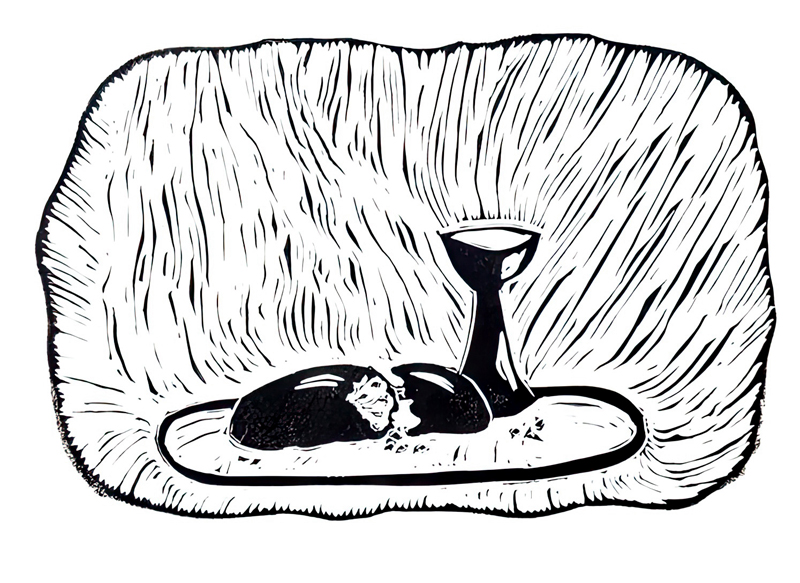
1 Corinthians 11:23-26 & John 13:1-17, 31b-35
Do this in remembrance of me. In Paul’s letter to the Christians in Corinth, we have the earliest mention of the Eucharist, Holy Communion, the Lord’s Supper. Paul was writing almost a generation before the Gospel of John was written, and decades before Mark or Luke or Matthew completed their versions. Before there was a New Testament, before there were Gospels to read aloud, before anything close to what we now call a Church had solidified, Paul was teaching people about the Eucharist, which he in turn learned directly from the Risen Lord. Paul wasn’t there, and if he had been there prior to his conversion he might have sided with Judas and the mob. He didn’t hear Jesus first say those words- “This is my body that is for you. Do this in remembrance of me. This cup is the new covenant in my blood. Do this, as often as you drink it, in remembrance of me.” But he knew the words, he remembered them as if they were spoken only to him, and he shared them with Jews and Gentiles in far away places, so that they too could proclaim the Lord’s death until he comes. He taught them how to bless the wine and break the bread, he repeated the words of Jesus and explained what they meant. Do this in remembrance of me.
This remembering, this blessing and breaking and pouring out and sharing, has been at the heart of Christian practice from the very beginning. The details differ from community to community, just as they differ slightly in the Gospels, but as a central act of communal memory, the Lord’s Supper unites us across borders and barriers and denominations and languages. Jesus told his disciples to do this in remembrance of him, and so we do.
Jesus knew that his time was near, that he was about to be betrayed and that soon his disciples would see him no longer in the way they had come to know him. He knew that eventually, he would return to the Father, where his friends and followers would no longer be able to see and touch him as they were used to. He knew the human tendency to doubt, to question, to forget. He knew that as time wears on, we lose the clarity of our memories; we forget the specific sound of a loved one’s laughter, we can no longer reproduce the sound of their voice in our minds, we forget the exact shade of their eyes or the way they wore their hair or the words of their favorite song. We are human, and we experience the passage of time as waves on a seashore: always bringing something new, but always also taking away what once was familiar. Jesus knew this, knew us, and loved us too much to leave us to our forgetting.
“Where I am going, you cannot come,” Jesus tells them. A heartbreaking admission, so very like a parent saying goodbye to a child who does not yet understand or desire separation. Where I am going, you cannot come. Do this in remembrance of me. Do this in remembrance of me. Jesus knew that when he left, his people would not understand. He knew that they might forget the details, might begin to question if he ever really loved them at all. He knew that someday we would be born, people who have never seen his face or held his hand, that between then and now the specifics of his features would be lost, leaving us trying to remember someone we never met. He knew we would need help to remember, so he gave us the Eucharist.
Eucharist comes from the Greek word for thanksgiving. Even to this very day, the word for thank you in Greece sounds like Eucharist. When I was a pilgrim in Greece, walking through markets and sitting in restaurants, it was breathtaking to hear such a familiar word on the lips of hundreds and thousands of strangers, a constant chorus of Eucharists exchanged for everything from a cup of coffee to a steadying hand on cobblestone streets. Efcharisto, efcharisto. Thank you thank you thank you. Do this in remembrance of me.
Jesus knew that we would need help to remember, he knew that we needed tangible things to remember and understand intangible truths. God became a body because we are bodies, and we cannot truly live in the world any other way. So when it came time to teach us how to remember, God chose to feed our bodies. Eat this, drink this. Do this in remembrance of me. Feel the bread. Smell the wine. Remember. Say the familiar words, hear the familiar story. Remember. I love you. Remember. The Eucharist, the thanksgiving, is God’s gift to our memory. Remember how I fed you. Remember how I nourished you, how you thirsted and I gave you living water. Remember how I loved you to the end, how I poured myself out for you and knelt to wash your feet. Remember that I did not leave you alone. Remember that I chose to spend my final moments with you, telling you with my words and with my actions how beloved you are, even when there is betrayal in your heart. Do this in remembrance of me.
What is the human response to divine love? What is our answer to the gift of memory, of real presence, the gift of himself given to us by Jesus? Eucharist. Thanksgiving. Thank you thank you thank you.
 Mother A Writes