John 18:1-19:42
Yesterday, we heard that the devil had put it in the heart of Judas to betray Jesus, and today we bear witness to the outcome of that betrayal. “The Devil made me do it,” a phrase popularized by a comedian in the 70s, has long been a tongue-in-cheek way of excusing minor infractions, a humorous passing of the blame. For the authors of the Gospels, the devil’s influence was no laughing matter. When Judas decides to betray Jesus into the hands of those who will take his life, it is easy to imagine a significant change must have come over him. An inhuman look in his eye, a shifting of his features into something unrecognizable. We might picture Judas as greedy, conniving, diabolical. For someone to commit such a heinous act of treachery, they must be truly evil, demonic even. If the Devil made him do it, then surely his soul was the price, right?
But notice who is missing in our reading of the Passion today. There is no mention of the Devil, no demonic possession, no Satan whispering in the ears of the crowd. In Matthew and Luke’s versions as well, the devil is only implicated in Judas’s choice to betray Jesus. In Mark’s version, the Gospel seemingly most preoccupied with demonic forces, Satan is not mentioned at all in the events of Jesus’s final days. There is no mention of a devil in the ear of Caiaphas, or Pilate, or the crowds, or the soldiers who flogged and mocked Jesus. It is human voices, not the voices of demons, who shout “Crucify him!” It is human hands that take up the hammer and drive the nails through the palms of an innocent man. Did the devil make them do it? Does it matter, if in the end God still lies dead and buried?
I learned recently that the familiar imagery of the red Tempter with horns and hooved feet and a pointed tail, pitchfork and forked tongue comes from an amalgamation of ancient pagan trickster gods and the imaginations of some influential poets. For most of Christian history, the devil has been depicted using animalistic traits- goats, snakes, bats. Unnaturally red skin, giant taloned wings, larger than life- these are the attributes of demons and devils throughout the early church and up into the Middle Ages. We experienced evil as something other, something grotesque and visible. We understood the devil to be something you’d recognize from a mile away, an enemy that can be fought with fists and swords and spears. It is only recently in human history that we have begun to know otherwise, begun to see the enemy as one that might be among us all the time.
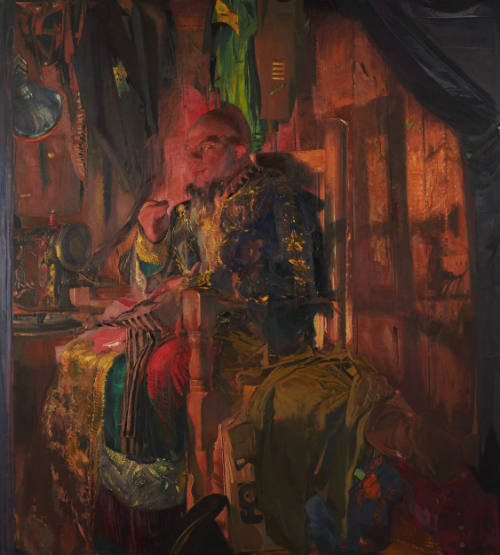
During the first world war, and especially during and after the second, the Devil got a makeover. He shed his red reptilian skin, traded in his pitchfork, and lost his horns. He became handsome, suave, charming. He started wearing a suit and a smile. In some hateful propaganda he was depicted with the features of particular ethnic groups, and in a particularly striking and disturbing painting he is depicted mending the uniforms of Nazi soldiers with a smirk on his face. The atrocities of war and genocide on a global scale fundamentally changed the face of evil in the human imagination. We began to understand that the Devil almost always looks just like other people. We learned that evil often looks like us.
So as Jesus hangs before us on the cross and lies entombed behind a stone, we must ask the question. Did the devil make them do it? Did the devil make us kill God? Does the devil make us hurt one another, abuse one another, make war against one another? Does the devil make us do every horrible thing humans are capable of? On this Good Friday, has Satan won?
I think that might be giving the Tempter a little more credit than he deserves. When we say the Devil made us do it, we say that Evil is more powerful than we are, that our God-given free will can be overridden. When we give in to the temptation to pass the blame, we deny our own agency and forsake Jesus ourselves.
You might also look at the horrors of the crucifixion, the horrors in our world today, and say that this is just who humans are. We are betrayers, thieves, murderers. We are inherently violent, irredeemably vicious, selfish creatures, and so the cross was inevitable from the beginning. You could say all of that, and you’d have plenty of evidence to support your claims. But that is a temptation too, a temptation to give up on humanity, to forsake one another to our fates and accept that reconciliation will never come. It is a strong temptation, but it is not of God. It is a trap of the Enemy, and we fall into it again and again.
Humanity may have been in the betrayal, and the wrongful arrest, and the false testimony, and the execution. But humanity was also on the cross. Humanity stood witness to the horrors of the crucifixion and heard the last words of Jesus. Humanity gave Jesus a proper burial in a dignified tomb. Humanity wept for him, and humanity kept watch until the new day dawned.
Good Friday is a moment when the forces of evil believe that they have won. The breaker of chains, the lover of souls, the anointed one of God has died, and the balance of power remains firmly tipped away from the poor and the oppressed. The mockery is the point. The crown of thorns and the purple robe are reminders for the living that the last will never be first. The violence is the point. The cruelty is the point. The body on the cross is a message from the powers of death, the final word on the life of Mary’s son.
But it is a lie. The devil is a liar, and the cross of death becomes the way of everlasting life. For this hour we are in darkness, but the light will come as sure as the dawn. Good Friday is the day we look evil in the eye and see ourselves reflected back. But if we turn our faces toward the cross, there also we will find our reflection, the God whose image we bear. That is the truth, the deeper reality. This story isn’t over.
 Mother A Writes