John 20:19-31
After the events of Holy Week, and the impossible news of Easter, I can’t blame the disciples for hiding away together. As a pastor, I understand the instinct. The events of Jesus’s final days before his death, the sham trial and gruesome execution, the long day of waiting and the baffling witness of the women- it’s an emotional rollercoaster for all of us, and we’re not even experiencing it firsthand. These guys have lost their leader, their teacher, their friend. They are all in various stages of believing what the women saw at the tomb, and they have no plan for tomorrow. In a nutshell, they are traumatized.
The women who went to the tomb on that Easter morning may not be faring much better. Remember that in Luke’s Gospel last week we heard that the men did not believe their idle tales. In Mark’s version, they didn’t tell anyone at all at first, so terrified and confused were they. In John’s version, a few of the men rush off to the tomb to see for themselves, but they don’t stick around long enough to see the resurrected Lord that Mary first mistakes for the gardener. Other than a mysteriously empty tomb, some discarded graveclothes, and a bizarre story from a tearful Mary, the disciples are stranded and wandering in the darkness of grief.
So when Jesus appears among them, I can only imagine that the rejoicing was preceded with shock, confusion, and maybe even fear. The door was locked, and this man did not enter through it. Not to mention he’s got holes in his hands and feet and a big gash in his side that is somehow neither healed nor actively bleeding. Zombie Jesus, the undead. Except he is not simply a reanimated corpse, or something from an action movie. This is the risen Lord, the resurrected Christ, the first fruits of those who have fallen asleep. Artistic interpretations often depict the resurrected Jesus with a slight glow about him, as if the light that shone through him on the mountaintop at the transfiguration is now permanently emanating from his skin. He probably greeted them with “Peace be with you” for the same reason an angel’s first words always seem to be “Do not be afraid”- his presence is overwhelming.
This body, this resurrected body of Jesus is somehow different from what it was before. As we know from this and other accounts that he can feel hunger, he can eat and drink and share fellowship, he can appear and disappear at will and he is not always immediately recognizable as the man they knew. But still, he is entirely himself. He is still the same person he was on the cross, and in the garden, and around the supper table. He bears the scars of the life he lived and the death he died. Perhaps, alongside the scars from the nails and the spear, he still has callouses from working in the woodshop with his foster father as a teen. Perhaps he has other scars, from burning his wrist removing bread from the oven or cutting himself on a hook while helping James and John haul in a catch. Perhaps the experience of incarnate humanity has left many indelible marks on the body of God, and perhaps he kept them on purpose.
You see, I think Jesus knew how important those scars would be to us. How important they would be to Thomas, to Mary, to all the shocked and grieving disciples who cannot believe their eyes and ears. Sometimes the scars are the only proof we have that we survived, that what we suffered was real, and that we are fundamentally changed.
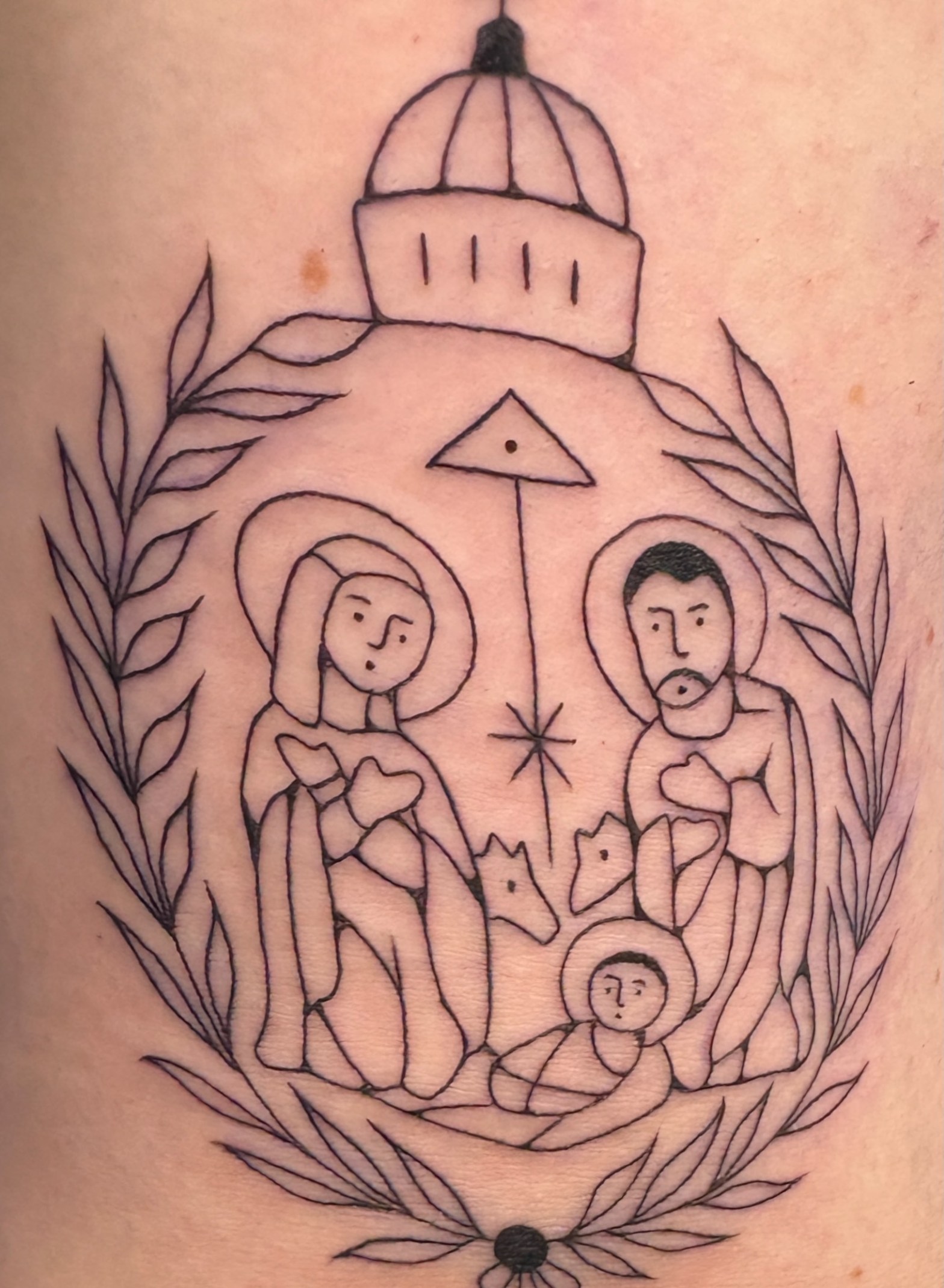
As you may be aware, I have tattoos. This is a risky thing, as a priest, I know. Not everyone likes the idea of tattoos, let alone a Christian leader who has them. Some of you may have no idea, if you only really see me here on Sundays in my vestments, but it is true. I’m one of those people. I am not saying that my tattoos, which I chose and paid for and which artists designed for me, are the same as the scars of Christ. But I do think they’re related, if you’ll hear me out. And before I go any further, no I am not advocating for everyone to go out and get tattooed, and I especially don’t recommend getting a tattoo before the decision-making part of your brain is finished developing, which they say is around 25. What I am saying is that when God became a body, he did not then trade that body in for some spiritual existence at the resurrection. When Jesus died and was raised, it was that very body, the one built cell by cell by Mary’s own body, that walked out of the grave.
Tattoos are scars. There’s a little more to it than that of course, but it is basically true that the tattooing process is controlled injury, a repeated wounding of the skin in order to create a lasting mark. Unlike much of the pain and injury that our bodies experience, these scars are chosen. They are designed by artists, they are born out of traditions and styles and milestones and life stages. In some cultures, men are tattooed after each of their children are born, and in others women are tattooed as a rite of passage into adulthood. In many cultures, including ours, some people seek out tattoos after a loss or a major life change. As the author Becky Chambers so beautifully explains it in one of her novels, in tattooing “You make a hazy imagining into a tangible part of you. […] You’re reminded that all these separate pieces are part of the whole that comprises you.” (The Galaxy and the Ground Within, pg 94)
The scars on his hands, the gash in his side; these pieces are part of the whole that comprises Jesus. When his friends are trying to understand, wanting to believe it is really him, it is these scars, tattooed into his flesh, that they look for, reach for. The person of Jesus cannot be separated from the body of Jesus. The Son cannot be separated from the flesh he took on when he came among us, Immanuel, God with us. We are not merely spirits having a bodily experience, we are bodies inseparable from the spirit, the pneuma, the breath which fills our lungs and which Jesus breathes over the disciples. It matters that Jesus has a body because our bodies matter. It matters that his resurrection was a bodily one, because it is our own bodies that return to dust and it will be in our own bodies that we see God and are reunited with one another in the life to come. Our wounds, our scars, our tattoos, our regrets, all the things that have injured and harmed and disfigured us, the things that might even make us unrecognizable to those we love- these things are not erased in the resurrected life. These separate pieces are part of the whole that comprises us, and because we are beloved of God even these pieces will be raised, resurrected, transformed. In the already and not yet of Easter joy, we know this transformation has already begun.
 Mother A Writes