Acts 9:36-43
When I was newly ordained, a woman in my first parish died and I was to preside at her funeral. Instead of flowers, her children told me they would be bringing some things she had made to adorn the altar. She was a quilter, and an embroiderer, with an artist’s eye. The day of the funeral, her quilts lay draped along the altar rail and across the backs of pews, having been collected from far and wide from the homes of children, grandchildren, great-grandchildren, and friends. On either side of the altar, frames of elaborately embroidered flowers stood as beautiful offerings and reminders of her love for the people who took the frames off of walls for the occasion. In the receiving line after the service, people pointed out the shawls she had made them; men pulled out handkerchiefs she had embroidered as wedding gifts; young people told me the stories of their quilts as they held them close like old friends, the traditional graduation gift in their family for generations. I always remember her when I hear the story of Tabitha. Their funerals were very similar, as are the legacies they left behind.
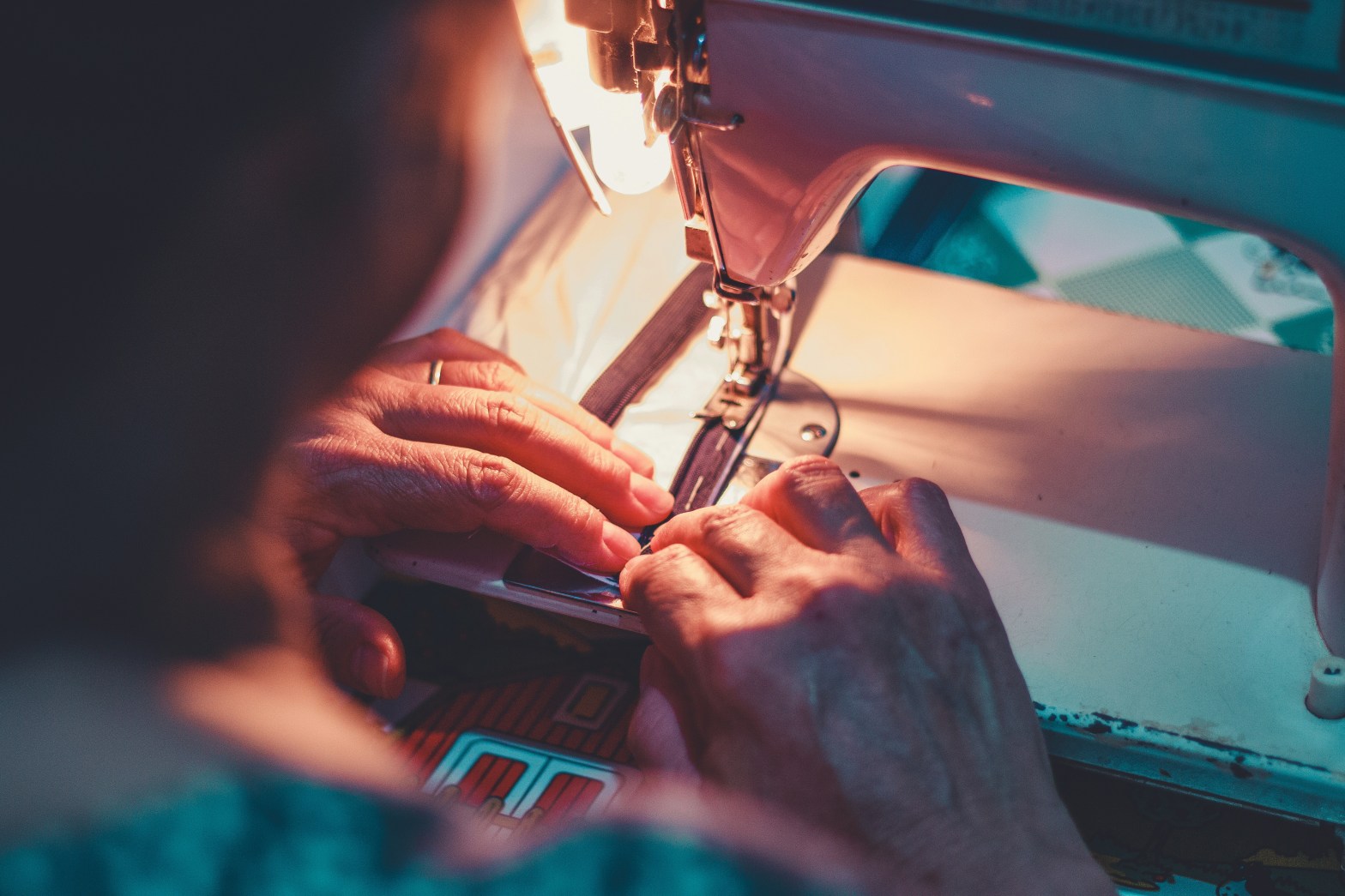
Tabitha is the only woman named explicitly in the New Testament as a disciple, and she is not depicted by Luke as having been converted by one of the apostles, meaning she likely knew and was a follower of Jesus during his earthly ministry. As a disciple, she imitates her teacher- in her case, through the work of her hands. Tabitha, also called Dorcas, made clothing to wrap up and protect and adorn the widows in her community. Much as we have members among us who prayerfully stitch and crochet and knit shawls, blankets, and articles of clothing to cover and comfort those they love and those who are most in need of care, Tabitha was a minister, and textiles were her ministry.
Anyone who has ever done textile work can tell you it is an intimate act to make something that will cover the skin of another person. You must take measurements and carefully place pins without injuring the wearer or damaging the fabric. You must consider how the texture of the fabric might feel against sensitive infant or aging skin, how it might hold up to being washed and if it will be safe to sleep in. For a shawl or a scarf, the weight of the yarn and the size of the stitches can mean the difference between something meant for adornment and something meant for warmth. Will the sweater feel like a warm hug or an itchy but protective outer layer? Will the embroidery catch in the day to day of a playful toddler or a busy high schooler? What color or pattern of fabric will show pet hair the least, so that this gift might not turn into yet another thing for the recipient to clean? Just the other day a member here at St Mark’s told me she was looking for the exact right shades to match the Sweet Briar colors for mini prayer shawls, a thoughtful attention to a community of young people in a tumultuous time of life. It is an intimate and sacred thing, holy ground, to create something with your own hands and then entrust it to the hands of another. But that is the ministry of textiles, and it is a ministry nearly as old as time.
Did you know that God is the first seamstress to make clothing for someone else in the Bible? After the first man and the first woman gave in to temptation and ate the fruit, their eyes were opened to their own nakedness. Before that moment, it had never bothered them that their bodies were uncovered. It had never occurred to them that they would be any other way. But after their betrayal, scripture tells us they saw that they were naked, and they were ashamed, hiding themselves by sewing fig leaves together. It saddened God that they hid, that they were ashamed of the bodies he created. But when it was time for them to leave the garden, God did not just let them leave with those flimsy leaves for protection. Genesis 3 tells us that God made garments out of animal hide for Adam and Eve, clothing them for their journey. The fig leaves were sewed together in haste and shame; but the animal hide garments were made for them by God, a gift of love and care made just for them. It is in the same tradition of such love and care that Tabitha continues her ministry.
Upon his arrival, the saints and widows who weep at the bedside of Tabitha immediately begin to show Peter the clothing that she had made for them. On their bodies and in their arms, they carried tangible evidence of Tabitha’s life, of her service and her love of the Lord. What a gift it must have felt to these women in their grief, to clothe themselves in reminders of the love of a dear friend. To be a widow in that time and place was to be vulnerable, limited in one’s ability to provide for oneself. If they were young enough to potentially bear children, they might be remarried, but if their childbearing years were behind them when their husband died, the protections of remarriage were extremely unlikely. They might have lived in the household of their sons, if they had them, or in the household of their father if he still lived. Apart from some wealthier widows, of which Tabitha may have been one, these women relied on the provision of others. Tabitha understood this and devoted herself to providing for them in every way she could.
The resurrection of Tabitha is miraculous, to be sure, but it is the life she lived before and after that I hope we can celebrate and emulate today. The resurrection is a gift freely given to us, a promise of God that we can neither earn nor lose. But to be a disciple, to be remembered for our devotion as Tabitha is- that is a choice each one of us must make for ourselves and collectively as a parish. She knew Jesus, and the ministry that flowed out of that knowledge ensured that the vulnerable people in her community were clothed in dignity. To clothe them, to meet their needs, she had to know them. She had to listen to them. She had to live alongside them, come close to them, pay attention to what they had and what they wanted. She put herself in the midst of those the world forgot, and in doing so she pointed to the love of Jesus who was already there with them.
This week, a doctor saw a prayer shawl, one of the over 600 mini shawls that have been distributed from St Mark’s, in the hand of a patient in the ICU in Lynchburg. St Mark’s has never delivered a basket of our shawls to the hospital, which means that either that patient brought it with them or someone else had one to share. That shawl, a tangible sign of love and care made by the hands and prayers of a disciple of Jesus, made its way from the hands of its creator to the person who needed it most, in their hour of greatest need. On its journey, that little shawl wound up back in the place that first inspired its ministry, as members of St Mark’s sat vigil at the bedside of their brother and friend Ed Hopkins, grasping for something to hold on to in their grief. A great theologian once wrote that ministry is the place where our deep gladness and the world’s deep hunger meet. It is out of gladness, gratitude for the gifts and skills God has given us, for the example Jesus offers us, that our ministries arise. This was true for Tabitha, the disciple and seamstress, and it has proven true for the many people who give their time and talent to our feeding and knitting ministries and so many other good works. May their example inspire us to offer our own deep gladness to meet the deep hungers of this world.
 Mother A Writes