Acts 16:16-34
Content Warning: This sermon addresses suicide, mental illness, and death.
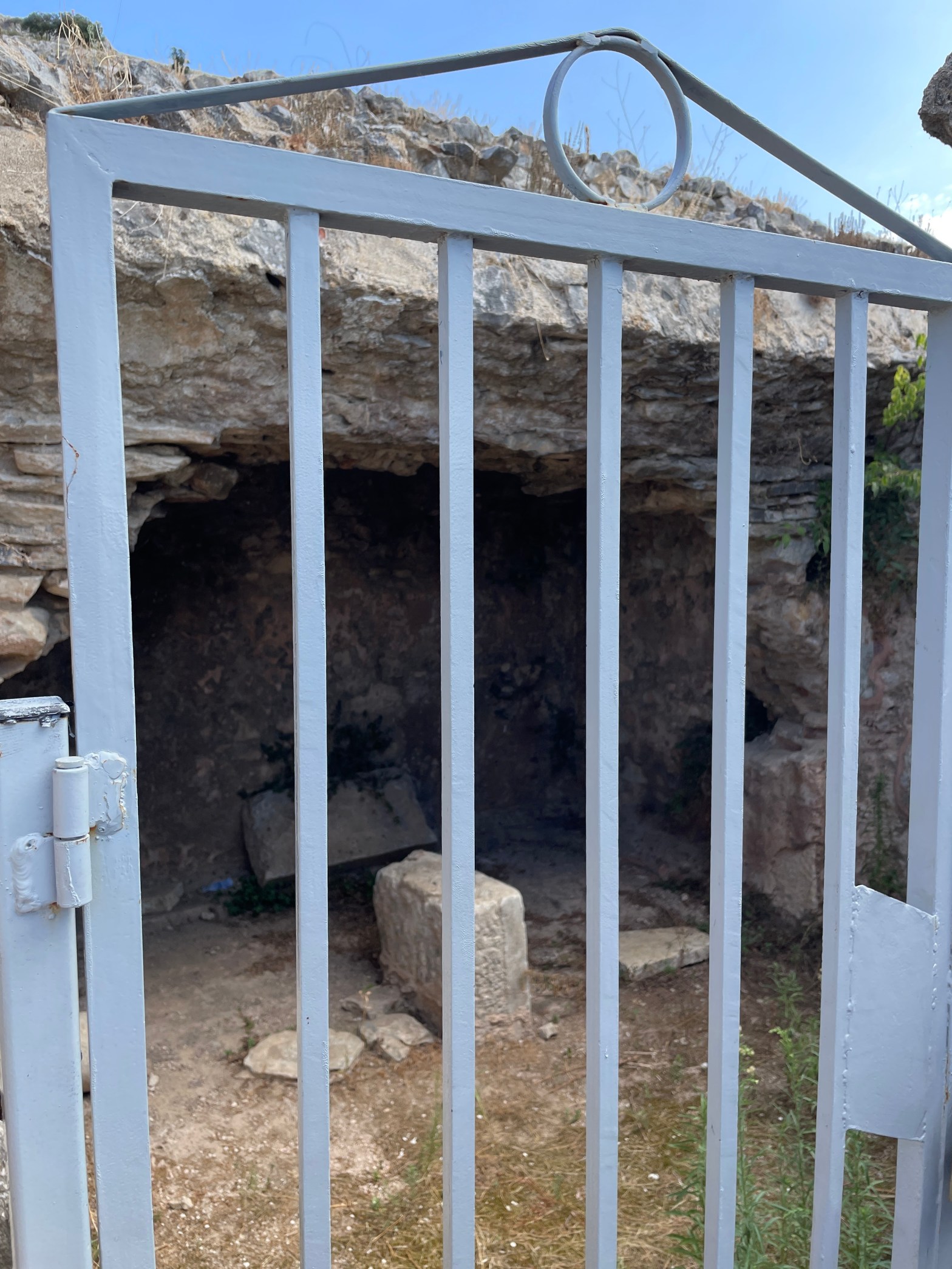
The photo associated with this post is a photo I took at the excavated prison cell in Philippi where Paul was imprisoned as depicted in Acts.
When I saw the readings assigned for today, I was deeply moved. This reading from Acts is one I feel a strong connection to, and I want to tell you why. But I want to warn you that it involves something very tender, and something that might be difficult for some of us to talk about. I am going to talk about mental health, and briefly about self-harm and suicide. If that is something you need to skip today, or a conversation you’re not ready to have with your child, I will not be hurt if you step outside for a few minutes. The text of this sermon will be posted to my blog, so you can read it there later if you would like to do so in a more private setting. I know this is hard, and for some of us it is very complicated. But I believe that church is where Christians go when things are hard and complicated, and where we might more clearly hear what God has to say about the things that break our hearts.
When I was on my pilgrimage in Greece and Turkey a couple of years ago, I was there with a very special group of people from a very special parish. My best friend Melissa grew up at St Michael’s Episcopal Church in Colorado Springs, where her parents are still active members and where her mother is on staff. In 2020, Melissa died by suicide, one of several young people associated with the parish who died in a short period of time. In the midst of their grief, the people of St Michael’s heard a clear call from God to care for those who suffer from depression, anxiety, and loneliness. A large percentage of the parish has since been trained in what they call Mental Health First Aid, an intervention to help people in crisis until professional support arrives. In addition to these trainings, they provide spiritual support, mental health resources, and advocacy for members of their community who are struggling with their mental health. They have a First Aid Mental Health Trainer-in-Residence, and their clergy have received special training to minister to people impacted by suicide. As their own broken hearts continue to heal from their losses, the people of St Michael’s have poured themselves into reducing the incidence of these kinds of tragedies. It is a truly Spirit-led ministry.
Well that’s nice Mother Allison but what does that have to do with the Acts reading? Good question. Paul and Silas are doing what they very often do- healing people, performing miracles, preaching and getting arrested for it. I could go into the story of the unnamed girl who is enslaved and exploited for her ability to divine the future, but that’s a different sermon. I could go into the feeling I had standing next to the very jail cell in Philippi where Paul and Silas were imprisoned, where they were stripped and beaten and confined with almost no natural light or ventilation. I could talk about the fact that in Ancient Roman jails, there was no provision for the prisoners- if you had no one on the outside to bring you food and water and clean clothing, then you would suffer starvation and dehydration and exposure to the elements. I could talk about Paul and Silas singing hymns to God from within their prison cell, and how the same faith led imprisoned civil rights leaders in this country to sing spirituals day and night in the jails of the American South. I could talk about the miracle of the earthquake that shook the foundations of the prison and somehow released every prisoner from their chains and unlocked every door without causing the prison walls to fall down on top of them. These are all important elements of this story, and worthy of their own sermons. But there is one line in particular that I want you to hear today.
When the jailer awakens and sees that the doors of the prison hang open, it is the end of his world. He will be held responsible for every escaped prisoner. Whether they were jailed for debts unpaid or for crimes against the Empire, the jailer will have to answer for every prisoner gone. It is very likely he will be killed, but at the very least he will be shamed and will lose his livelihood, his home, and possibly his community. He sees no way out of the suffering to come, and the author of Acts tells us that he draws his weapon and prepares to take his own life. But a single voice cries out in the darkness. Do not harm yourself, for we are all here. Paul perceives that a tragedy is about to occur, and he does what he can to intervene. He does not let the violence of his own arrest and imprisonment turn his heart toward revenge. Do not harm yourself. With a voice strained by pain and hours of singing, Paul saves a life. Do not harm yourself, we are all here.
The people of St Michael’s in Colorado Springs have known the unspeakable pain of loss, and in response they have offered their voices and their presence in the hope of preventing more loss. I stood with them at the doorway of Paul’s jail cell, and I heard them say “Do not harm yourself, we are all here.” Paul and Silas sang hymns to God in that jail cell, and the other prisoners listened. When the doors opened, not a single prisoner fled. They stayed, that they might learn about the God that had broken their chains from people who had been beaten black and blue and somehow still sang hymns. So when Paul told the jailer, We are all here, he meant all of them. A community of faith, newly birthed in a foundation-shaking earthquake. That was the church, a Christian community founded in Philippi, shouting to the jailer that he is not alone.
I believe that this is the work of the church in a sentence. Do not harm yourself, for we are all here. Do not be afraid, do not do the things that hurt you, do not punish yourself, do not succumb to the oppression of the empire, do not answer the violence of the world with violence upon your own body. Do not harm yourself, for we are all here. The church’s response to suffering is to say “we are all here.” We are with you. Through Christ, we are never parted from you. Through Christ, you are never alone. We are all here. When the horrible thing happens, when tragedy strikes, when the loneliness threatens to overtake you, when the anxiety and fear overwhelm you, we are all here. We, the Church, the body of Christ, your brothers and your sisters, are here. We are all here. Thank you for being here. Keep coming back.
 Mother A Writes