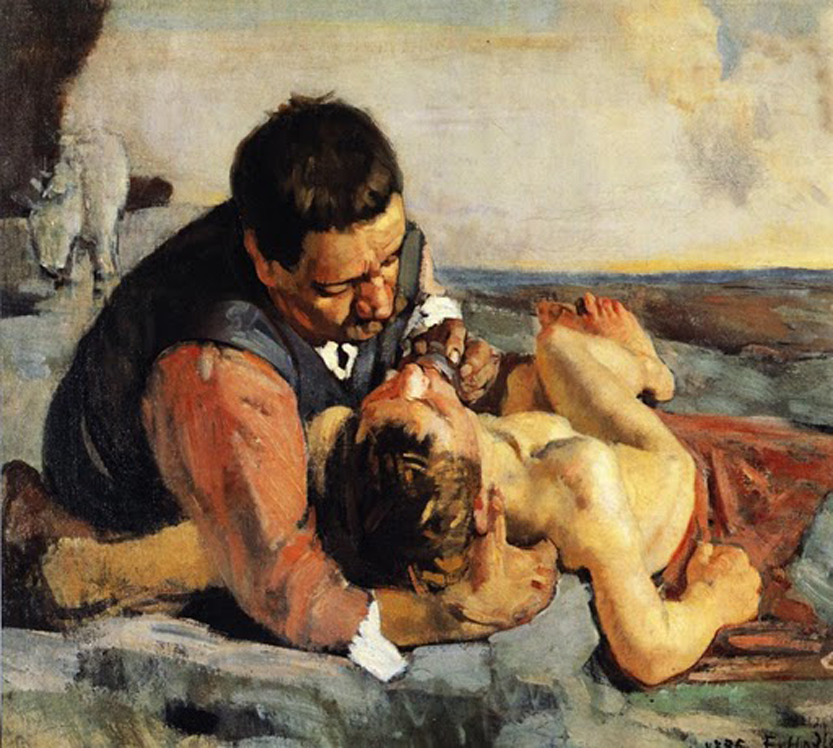
Luke 10:25-37
The parable of the Good Samaritan looms large in the Christian imagination. The role of the “good Samaritan” is embedded in our cultural vernacular and enshrined in our legal codes. College students attend trainings when they arrive on their campuses in which they are encouraged to be a good Samaritan, an active bystander instead of a passive one. Hospitals and churches and schools and relief organizations are named for the Good Samaritan, and an international suicide prevention organization bears his name as well. We all look at this familiar parable and we know who we hope to be in the story. We hope not to be the priest or the Levite who looked the other way and crossed the street instead of rushing to offer assistance. We hope to always be Good Sam, the good Samaritan with a generous heart free from prejudice and compassionate in a crisis. We hope to be the savior, offering healing and care to the downtrodden and the distressed.
But lately I’ve been wondering if there’s more to it than that.
Of course, we should all go and do likewise, loving the Lord our God with our heart, soul, mind, and strength. Of course we should all see the person lying in the ditch as our neighbor and help them as best we can. Of course we should behave like the Samaritan in the parable, crossing every religious and cultural and ethnic barrier to bring care and healing and hope to people who are hurting. I feel very confident in that being our ultimate calling as Christians, as people of faith and goodwill.
But something has been bugging me, pushing me, challenging me not to leave the story there. There’s more, there’s something deeper and more complicated here. Jesus rarely, if ever, tells two dimensional stories, and something tells me this parable is more than just an example of the kind of bystander Jesus wants his followers to be.
We are led to assume that the man who is attacked is a Jewish man, coming down from Jerusalem through a very Jewish area. The priest and the Levite are both Jewish. The person who helps the injured man is not Jewish, but Samaritan. Samaritans and Jews in the Ancient world disagreed on some very important points in their religious practice and history, and there was a long and painful history of violence and desecration by groups on both sides of this ethnic and religious divide. Jews and Samaritans overall did not socialize, or worship together, or intermarry. In some areas, they would not do business with each other at all, functionally segregated and at times openly hostile. Before we chalk this up to the petty nationalistic rivalries of a more primitive time, I would remind us that the laws of this land imposed much harsher segregation in living memory, and the ghosts of those systems continue to haunt and harm us all.
The scandal of this parable is that the injured man on the roadside might not have accepted the help of a Samaritan had he been conscious and able to reject it. He might have chosen to wait in the ditch, bloody and bruised, for another Jewish person to stop and help him. Perhaps he had already watched the priest and the Levite cross the road to avoid him, and he only accepted the help of an assumed enemy out of desperation after suffering the rejection of his own people. This man has been the victim of a violent crime, but receiving the help of a man from Samaria is adding insult to life-threatening injury.
And yet, the help still comes. The Samaritan man administers first aid, provides shelter, and leaves a blank check for medical care and sustenance for a man who likely wouldn’t have shared water with him if they were both at a well in the middle of the desert. He saw his neighbor, and he loved him, and that love saved a life.
This is the part of the sermon where you usually get your inspiring reminder to be a good neighbor, to act like this Samaritan man and go out and help people in need without pausing to check their ethnicity or their religious background. I trust y’all are already doing that, or at least trying to. Today, this week, I want to challenge you to do something else.
What if, instead of standing in the charitable shoes of the Samaritan, you found yourself lying prone in a ditch? What if, instead of being a savior, you are actually the one who needs saving?
Face first in the mud, or maybe on your back staring up at an unfeeling sky, battered and broken and sore, somehow hungrier than you’ve ever been and desperate for a little water to soothe your scratchy throat, raw from crying out for help.
People walk by. You hear them, you know they must hear you, but they don’t stop to talk to you. You hear them pause, you can almost hear the argument taking place inside their head before they quickly scamper across the road and out of earshot. Finally, a shadow falls across your face as a hand reaches down to check your pulse, to haul you to your feet and onto the back of a donkey. Your consciousness slips in and out with the pain and the exhaustion, but you can tell this person is not like you.
Who is the equivalent to us today to a Samaritan in Ancient Israel? Perhaps someone from the country you’ve been taught by decades of media to hate. Perhaps someone with an accent that instantly sets off every alarm in your head. Perhaps someone who voted differently than you do, with bumper stickers and yard signs that make your skin crawl. Perhaps someone you have been taught to fear, or distrust, or cross the street to avoid.
We sometimes get too comfortable identifying with the savior in the story. We see this Samaritan doing someone a good turn and we nod our heads and assure ourselves that we would do the same if the right circumstances presented themselves. We forget that we are nobody’s savior, least of all our own. We forget that we too need saving,
Jesus is the unexpected, undesirable, unknown person whose hand reaches down into the ditch to pull us out. Jesus is the outsider, the foreigner, the person who has crossed borders and barriers to be where we have the good privilege of being born. Our savior does not look or sound or dress like us, he wasn’t born where we were born and his family looked different from many of ours. If we ran into him on the road, we might even be tempted to cross over to the other side. But still he shows up, and hauls us to our feet, pours ointment over our wounds and makes provisions for our continued care. He challenges us to reimagine the concept of neighbor, and he starts by becoming a neighbor to us.
We all struggle at times to acknowledge that we need help to get out of the ditch. The world beats us up, grief and loss and anxiety and fear leave us battered and bruised and cynical. We want bootstraps, not pity. We want to make our own way, not be hauled on someone else’s journey. We want to give to charity, not accept charity from others. But our savior keeps showing up in the deep places, lifting us up and tending to our wounds. Our faith is not built on self-reliance, but on the admission that we need God, that we need one another. As Christ shows up in the Samaritan on the road, so too Christ shows up in the people and places we least expect. So I ask you to ponder the question today. Who is the person or group you view as your enemy? Who, when you are honest in your heart of hearts, would you struggle to receive help and care from? Whose hand would you struggle to take if it was offered? We are all human, and none of us are Jesus, so there is someone that fits this description for every one of us. Who is your neighbor? Would you let them be a neighbor to you?
 Mother A Writes