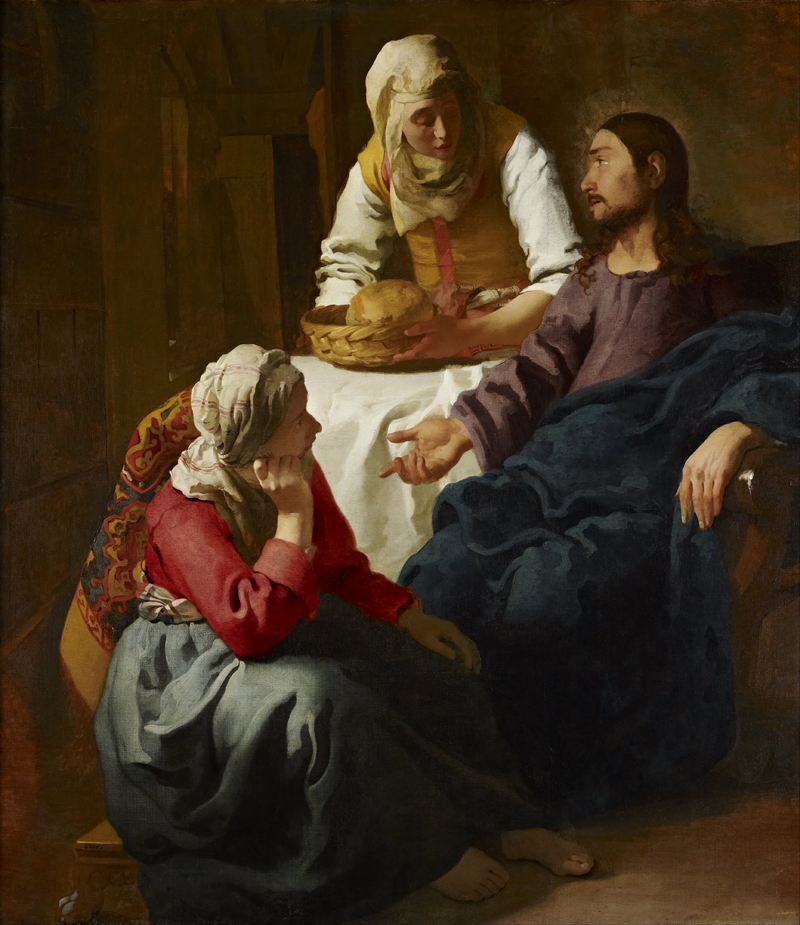
Luke 10:38-42
A few months ago, I had the opportunity to participate in a Bake & Pray workshop at St John’s in Lynchburg. Some members of St Mark’s also participated in the workshop, which was open to the community. My friend Maria, a talented baker and lay minister, led us in the art of baking bread. But it wasn’t just a seminar on sourdough and the best kneading techniques. The Bake & Pray method is special. It is slow. It is an invitation to find the spiritual in the practical, to invite God into the kitchen with us and to recognize God is already there. Each step in the recipe includes a prayer, or a passage of scripture, or a moment to pause and reflect on what God might be teaching us through the physical parable of yeast and the softness of flour and the stickiness of dough waiting to rise. The bread we baked required patience, multiple rises and folds, and finally time in the oven. In the moments in between, while the dough was resting or rising or baking, we breathed deeply and talked about our faith and got to know our neighbors. We shared a meal and communion, a taste of the same kind of bread we would be taking home at the end of the workshop. I shared in one of our conversations that I had baked bread before, but it had always been something I did in the middle of other things- I might prep the dough, then spend the entire proofing time cleaning or preparing other food or running errands or writing my sermon. It felt unnatural, I itched to DO something active during those rising times at the workshop, but Maria invited me, invited all of us to slow down, to pay attention to who we were with and what we were doing in the moment. It was transformative, resting while the dough rested. It was uncomfortable at times, not easy, and I would be lying if I said I’ve replicated the method perfectly every time I’ve baked bread since. But the act of baking bread in community, challenged and held accountable to a slow and prayerful posture, was eye opening. As much as I preach, both from the pulpit and in the rest of my life, about the importance of rest and recreation and contemplation, I’m just as prone to worry and distraction as the next disciple. To choose the better part is no easy thing, and we rarely can accomplish it on our own.
Our poor maligned sister Martha would have struggled as much as I did in that workshop, I think. Mary might not have connected with it either, honestly. Bake & Pray as a method requires the contemplative and the active to coexist, to comingle and inform one another. For generations, this sister pair has been turned into icons of the contemplative and the do-er, the passive and the active, the listener and the worrier. I find it interesting that these 5 verses define Mary and Martha in our minds, despite the fact that both play starring roles in some pretty major stories in other Gospels. We divide ourselves into the Marthas and the Marys, as if they are mascots for two schools in a college rivalry. We might accuse someone of being a Martha in a moment of frustration, or we might deeply identify with her and feel annoyed with Jesus for dealing with her so harshly when we could see ourselves behaving the same way. Somehow, the fact that Mary washed Jesus’s feet and Martha confessed him as Lord well before many of the male disciples figured it out never seem to factor in to the ways we align ourselves with them. As someone who is very close to my sisters, I’ve always been a little mystified by the insistence on framing this as a petty sibling rivalry, as if there aren’t many glaring examples of parents causing such rivalries with clear favoritism throughout the Bible. We never meet or hear anything about Martha, Mary, and Lazarus’s parents, but it seems safe to say there’s probably more to that family story than we get in the pages of scripture. Somehow, I don’t think I remember ever hearing anyone refer to themselves as a Lazarus, despite the fact that we can safely assume he was present for this moment in his sister’s house.
I don’t feel particularly compelled by the version of the story where we boil down two people into symbols and elevate one over the other. I think that Mary was herself, and Martha was herself, and each of us must strive to know our own selves well enough to hear whatever Word Jesus has for us today. But there’s still the pesky fact that, whether we like it or not, Jesus clearly expresses a preference- not for a person, but for a behavior, a posture. He says that in this moment, Mary has chosen the better part by putting down all that she carried in order to sit at his feet and listen to him. Martha’s busyness, her serving and hosting and rushing, have kept her apart from Jesus and from the rest of the community, and Jesus gently chides her for it. Not because what she is doing is wrong. Not because he does not love her. But because he needs her to know that her productivity is not why he loves her. He needs her to know that her service is not why he loves her. Jesus stops Martha in the midst of her distraction and worry because in the midst of it all she has forgotten her belovedness.
Jesus points to Mary because Mary is not doing anything at all. Jesus points to Mary because Martha looks at her and sees what the world sees, what we all see when we are honest. We call it laziness, we call it selfishness, we call it mooching or sloth or taking advantage. We punish it in ourselves; we chide ourselves for sitting down too long, sleeping too late. We judge others for the PTO they take, the boundaries they keep. We keep mental tallies of the number of times someone says “No,” and we begrudge younger generations the rest and support we did not get. But not Jesus. Jesus looks at Mary, sitting down on the floor while there is hosting to do, drinks to refill and pots to stir, and he sees someone with ears to hear. Martha, God bless her, can’t hear Jesus over the noise of incomplete tasks and unmet needs and guests scraping the bottoms of empty bowls. Her to do list is running on a loop behind her eyes, while Mary has chosen in this moment to put the lists away and listen instead. Not because she is better than Martha. Not because she is more beloved, or even more spiritual. Mary has just made a choice to slow down, to rest like dough in need of rising, and in that choice she has claimed a front row seat to the teachings of Jesus. I hope and pray that Martha slowed down long enough to listen, to really hear. I hope she sat down next to her sister, and I hope she let Jesus refill her cup. I hope we can allow ourselves to do the same.
 Mother A Writes