Jeremiah 18:1-11
When I was in middle school, I had the great privilege of taking 3 years of art classes from a wonderful teacher who exposed us to a wide variety of mediums and methodologies. We did everything from charcoal to printmaking to egg tempera painting, and the one medium I never quite got the hang of was clay. We spent weeks learning about clay- how it was harvested and processed, what methods have been used to shape and temper it since prehistoric times, and how something that is essentially mud can become so permanent that it would outlast its maker by thousands of years. We attended demonstrations of pottery wheels and learned about the various temperatures and types of kilns. And finally, we sat down with lumps of clay in front of us and got to work.
I wish I could tell you that I created something beautiful and useful, especially given that bit about ceramics lasting longer than almost any other art form. Unfortunately, despite my exceptional public school art education, I was still a clumsy middle schooler whose gifts were better displayed in the written word and other two-dimensional mediums. I made what can be generously described as a very abstract whale, complete with a stand shaped and glazed to look something almost like water. I was very into marine creatures at that time in my life, but that did not translate to an anatomically correct whale figurine. God bless my parents for still choosing to display it when I brought the thing home.
It is rare that I have cause to reflect on my limited knowledge and experience with one of the oldest art forms in the world, and almost always that cause is the Bible. God the potter is an ancient and beloved image of the creator, found as far back as Genesis, when God shapes the first humans from the dust and clay of the earth.1 Being clay in the potter’s hands is a familiar image of surrender, a recognition that God continues to work with and shape us even when we cannot immediately feel or see the impact. There are hymns2 and poems calling for God to mold us like a potter molds clay, and even Paul in his second letter to the Corinthians refers to the Gospel as a treasure kept in the clay jars of our human hearts, vessels made by God and filled with the light and power of God.3 For Jeremiah to be ushered by God to the potter’s shed is not surprising- it is a logical place for the prophet to find an image of the invisible and ever-present God.
Although the metaphor of God the potter seems at first to be a straightforward and easy one to understand, the Word of God to Jeremiah carries an unexpected sting for such a quaint image. Once again in Jeremiah we hear God referring to plucking up, breaking down, destroying, bringing disaster, shaping evil, devising plans against the people of God. God the potter who shapes evil against us sounds more like a destroyer than a creator.
But the potter very often does find themselves in the position of destroying what they have created. A crooked or misshapen piece of pottery can sometimes be salvaged through gentle correction, remoistening the clay and applying pressure to redirect the progression of the vessel. But sometimes, the shape has become so crooked, the design has gone so awry, that all that is left for the potter to do is to smash the clay back into its original shapeless form, and start again. The clay is not thrown into the garbage, or tossed aside and replaced with new materials. The potter reforms, reshapes, restores the clay through touch and the application of water so that a new creation may come into being. Even clay that has been fired and shattered in the kiln can be repurposed, ground down and added to fresh clay to strengthen it. In fact, the ancients often used broken pieces of fired pottery to sharpen tools, everything from kitchen knives to farming and gardening implements, an old creation enabling the new.4 There is no reason to believe that God the potter intends to cast aside perfectly good material simply because the people have wandered astray of their purpose. If God did not wish to mend the relationship and reshape the community, what would be the point of sending a prophet? God gives these words to Jeremiah because God dreams of healing, a return to wholeness and an ending of the harm the people have caused to themselves and others.
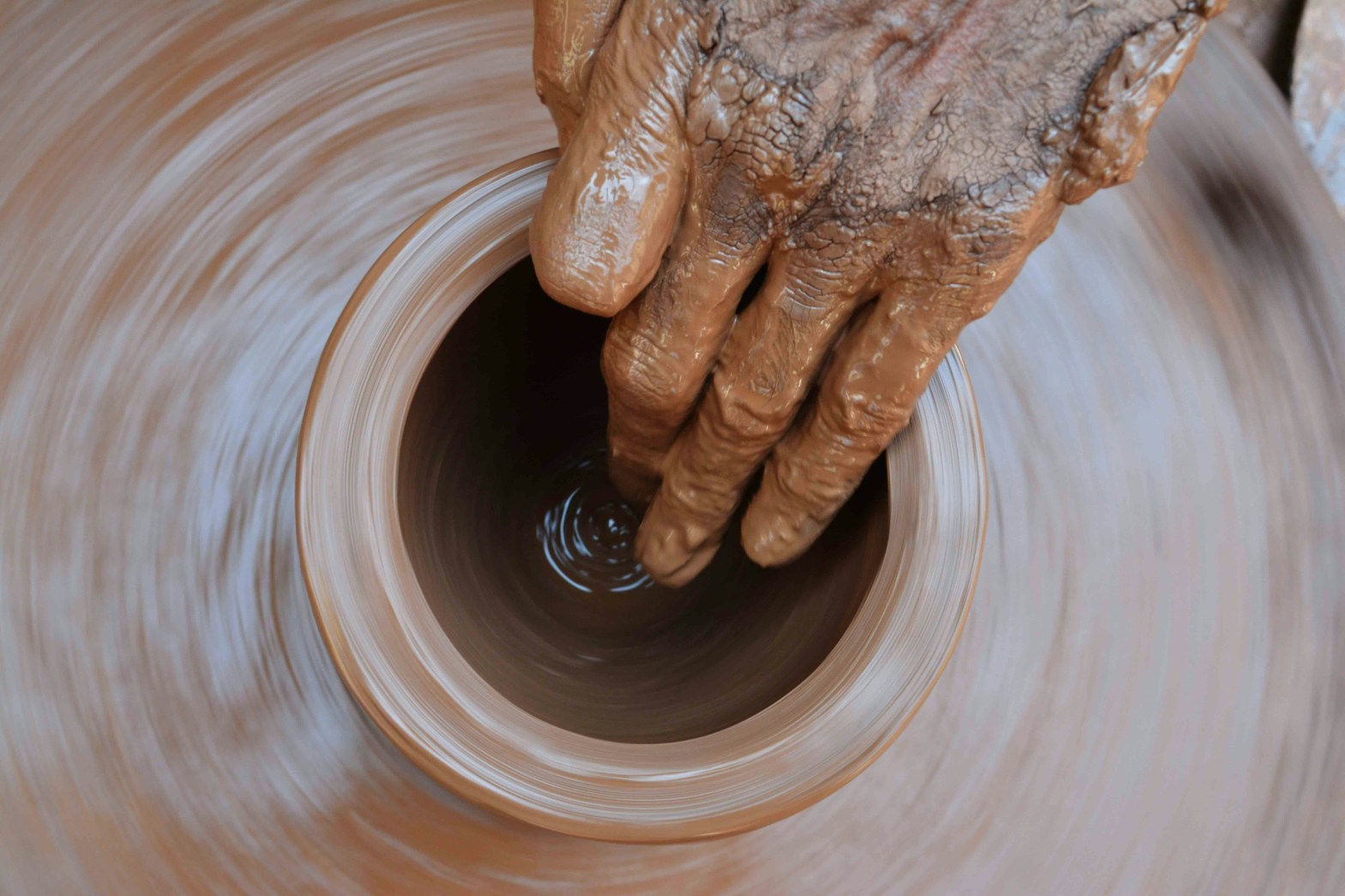
The process of reforming and reshaping clay is a messy one. It requires wedging, the process of kneading and folding the clay to remove any air bubbles. It requires the application of slip, a mixture of water and clay, to rehydrate the clay and make it malleable in the potter’s hands. The potter’s hands become covered in clay and slip in the process of shaping pottery on a wheel, and in the process moisture and oil are pulled from the skin of the potter into the clay on the wheel. Potters often develop callouses from repeated contact with the abrasive materials of pottery, and there is an entire market for restoring moisture and protecting the hands that can become dry and cracked over many hours of work. The potter shapes the clay, but the clay leaves its own marks on the potter. So also, our God who identifies with the potter is not unaffected by the reformation process. God’s heart is grieved when we do not hold our shape and collapse in on ourselves. God is disappointed by the ways we choose to go that diverge from the good design God dreamed for us, and God desires our repair. God sees us going crooked on the wheel, and God interrupts the process to make room for restoration.
The God who shapes us does not simply walk away from the wheel when we go a bit wonky- God actively participates in our reformation, our reshaping and rebuilding. Sometimes that requires a small shift- other times it requires the clay vessel be smashed and the potter start again on the same lump of clay. Sometimes this process happens many times over before the vessel is ready. Even then, the process is not over. The clay must first be left to rest and dry a bit, or else it will explode in the kiln. Then, a first firing removes the rest of the moisture from the clay so that it can be handled without changing its shape. This is the point at which the potter may apply glazes, possibly many times over with periods of drying and firing in between. It is only after many rounds of strengthening in increasingly higher temperatures over many days or weeks that the vessels can be rightfully called ceramics and put to the use for which their creator envisioned.
If God is the potter who reshapes the clay, then there are no foregone conclusions. Our mistakes, our flaws, our bent and crooked systems do not have the final say. Change is possible, and that change is an act of co-creation between God the potter and we the clay. Like clay, we can put up resistance, we can cling to forms that do not serve and solidify into shapes that do not hold water. But by the waters of baptism, we consent to becoming pliable, changeable, open to the reformation that leads to new creation. We acknowledge the need for something greater than ourselves, hands to mold us and fire to strengthen us, and we accept our part in becoming something new. Jeremiah brings us the Word of the Lord because we are more than passive participants, more than ineffectual witnesses of an out of control world. The prophet comes to us because we have the capacity to turn, to amend our ways and our doings, to become the clay jars which carry the light and power of the Gospel into the world. We can allow God to shape us into something beautiful. May it be so.
 Mother A Writes