Luke 17:11-19
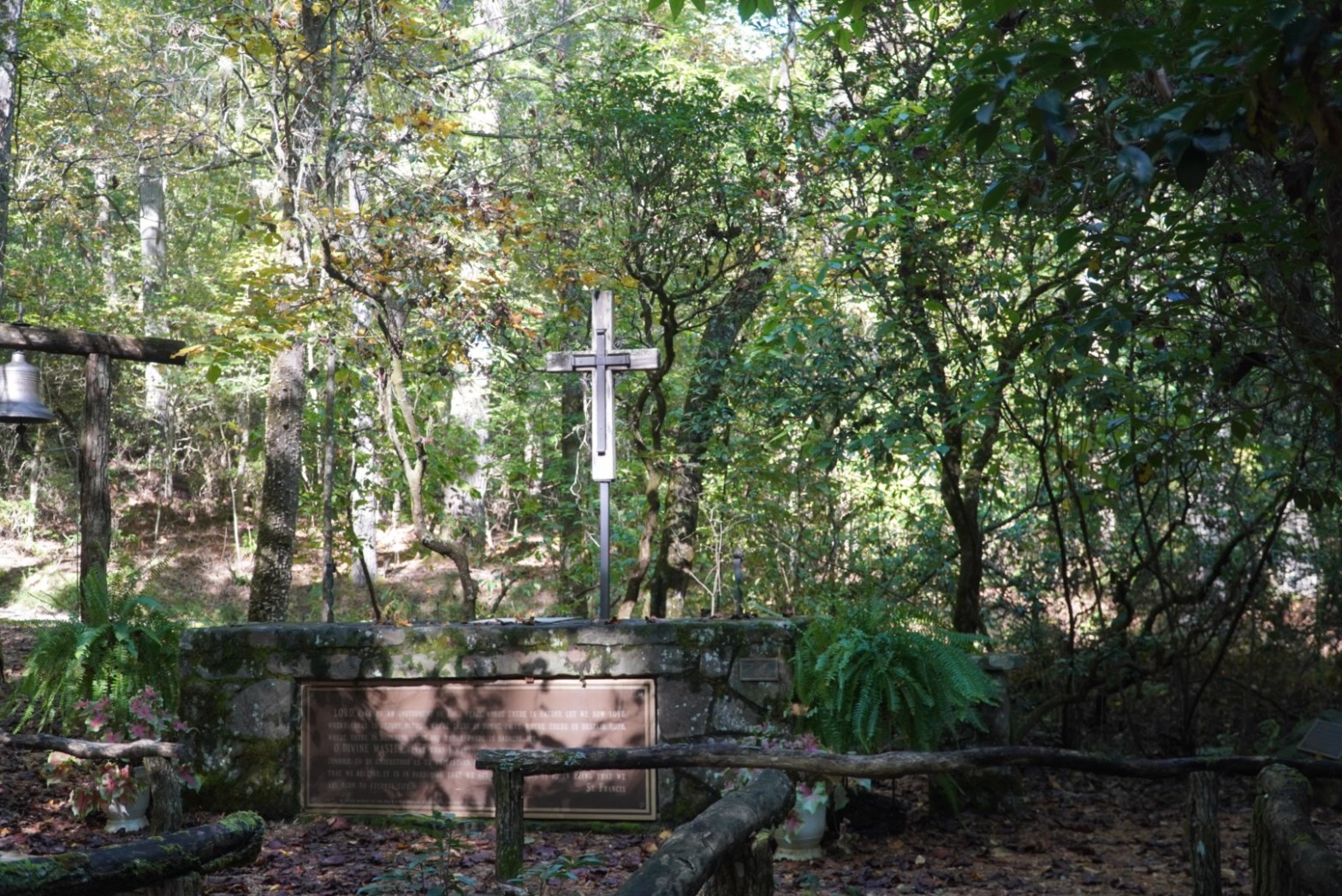
I am indebted this week to Mary Karr and Anne Lamott, both of whom have done much to shape my own prayer life. The essay by Mary Karr that is referenced here is “Facing Altars: Poetry and Prayer” found in the journal Poetry. Anne Lamott’s book Help Thanks Wow: The Three Essential Prayers features heavily here, about which she spoke in this NPR interview and is well-worth the read. I also highly recommend her other works including Traveling Mercies, which was a formative part of my early vocational discernment. The photo was taken by me in the St Francis Chapel at Kanuga during my first residency as a Kanuga Fellow!
As I reread our Gospel passage from Luke for this morning, I was surprised to realize that I had been thinking of this healing story as a parable, not a real event. In my mind, the story of the 10 lepers, the nine who did not return and the one who turned back to say thank you, has been lumped in with parables like the prodigal son and the lost sheep. Approaching this story as a parable is tempting. Turning people into symbols and illness into an object lesson makes for straightforward sermonizing. Writers and activists of the Disability Rights Movement have long pointed out the problem of reducing people with disabilities and chronic illnesses to inspiring stories and cautionary tales. The lepers in this narrative are people living with various chronic illnesses that have disabled them. They are not able to live with their families, nor are they able to find gainful employment except in the most undesirable of jobs, and many must beg to survive. They are not able to enter the Temple in Jerusalem, and they do not have access to communal worship in the local synagogues. They live, literally, on the margins, on the roadsides and the outskirts of towns and cities. And yet, Jesus here is encountering a group of ten of them, a small community of people living together and forming community where none was supposed to exist. Although it is likely they were suffering from a diverse group of visible skin conditions, they share a reality and a lived experience and so they have come together. We even learn at the end of the parable that this is a religiously and ethnically diverse group- the majority of the group appear to be Jewish, but at least one is a Samaritan! Like the early followers of Jesus, this small group of disabled people includes people that polite Jewish society would ignore and even scorn. Jesus meets them on his way to Jerusalem, in the liminal region between Samaria and Galilee. In this in-between place, a group of outsiders approach the wandering preacher, and walk away transformed.
So if we are not to turn them into a parable, we must encounter them as Jesus does- as people. They do not come near him; unlike many healing narratives they never receive the physical touch of Jesus. Instead they call out to him from a distance, and from that distance Jesus sends them to the priests to be declared clean and readmitted to mainstream society. On their way, the men witness the miraculous healing of their neighbor’s skin, and look down to see their own is now without blemish, perhaps for the first time in years or decades for some. The pain, discomfort, and distress that often accompany skin conditions are soothed and fade into memories. Nine of the ten go rejoicing to the Temple, cheering and shouting and celebrating together. But one turns back, not toward the holy mountain of his own people, but toward the one who healed him. Luke tells us this man praises God with a loud voice and throws himself prostrate at the feet of Jesus in gratitude. Jesus celebrates with him, and sends him on his way, made well.
What does this man teach us? Why does Luke include this story, one of several involving lepers and one of several involving Samaritans?
What we have in this story, this miraculous healing of ten people, is prayer lived out.
Poet and essayist Mary Karr struggled with active addiction, her drinking affecting her health, her safety, and her ability to parent a new baby and survive the hard road of single parenthood. Her friend Janice, a fellow recovering addict, issued her a challenge: “pray for thirty days, and see if [she] stayed sober and [her] life got better.” An atheist raised in a household with no religious convictions, Mary was skeptical. She shares in an essay that she knelt in prayer spitefully at first, belligerently, angrily. She knelt every morning and said to God “Keep me sober” and every night “thanks.” And after several years of trying, of brief glimpses of sobriety followed by long stretches of relapse, somewhere in the midst of these thirty days, Mary realized she was no longer drinking. Her sobriety continued, and with it came a baptism and a child who asked her to take him to church and a bestselling book that changed their financial picture forever. Although Mary learned other prayers, favoring the St Francis Prayer in particular, she continues to lean on the two prayers that saved her- Help, and Thanks.
Anne Lamott, another author and recovering addict who came to faith kicking and screaming, adds a third prayer to the list. For Anne, the fundamental forms of prayer are Help, Thanks, and Wow. Help, the desperate cry to God. Thanks, the deep sigh of relief and acknowledgment of God’s presence. Wow, the unbridled awe that everyday miracles evoke in us, whether they be as simple as a sunset or as profound as a newborn’s first cry. Anne proposes that every human prayer, every utterance to God falls in one of these three categories. Anne talks about prayer as the moment when everything goes from black and white to color, the moment when the new glasses reveal the world with startling clarity, the moment when the ticker tape of our thoughts and solutions gives way to something greater.
In the life of the Samaritan man healed of leprosy by Jesus, we see the unmistakable pattern of prayer.
“Jesus, master, have mercy on us” – Help
“Then one of them, when he saw that he was healed, turned back, praising God with a loud voice.” – Wow
“He prostrated himself at Jesus’ feet and thanked him” – Thanks
God is not a vending machine, prayers and thanksgivings put in like coins in exchange for the outcome we want. The other nine men were healed just as well, and they were following instructions by continuing on to the Temple to see the priests. They very likely praised God too, and made thank offerings in the Temple as was the custom of their people. Even if they hadn’t, even if they chose to go straight home to their families instead of making the journey up to Jerusalem, even if they never voiced their thanks to Jesus, their healing was already complete. Their healing was a miracle, no matter how they chose to respond.
But for us, disciples of Jesus and students of the Word, the Samaritan man is our teacher today. The Samaritan man embodies the vulnerability of prayer- the risk of asking God for help; the tenderness of giving thanks; and the wild spectacle of praising God in the sight of all. This is a man who prays, and who responds to God’s action with words and action of his own. We know that he must have made quite a scene, because his jubilance was remembered and recorded and passed down so that we might hear of it here, today.
What would it look like, if we prayed like the Samaritan leper? What if we asked God for mercy, for help, even when there are no words for the kind of help we need? What if we took every opportunity to say thank you and wow, to look directly to God in gratitude for the little and the very big things?
Mary Karr writes that in the early days of her prayer life, in the midst of a deep depression, a mentor told her to say thanks. She says “I started following his advice by mouthing rote thank-you’s to the air, and right off, I discovered […] There was an entire aspect to my life that I had been blind to – the small, good things that came in abundance.” Anne Lamott says that the full prayer is actually “the prayer of relief that help is on the way […] Thank you thank you thank you thank you.”
What Mary, and Anne, and the Samaritan man understand is that prayer is for everyone, in every moment, for every thought and word and deed and all that is left undone. When the Samaritan fell to his face in thanksgiving, he was not only giving thanks for his own healing. His prostrate Thanks was offered for his fellows in recovery, for the nine who went home, and for the countless others that Jesus healed who were speechless in their joy. When we pray Help, we are putting the world in God’s healing hands. When we pray Thanks, we are holding up a mirror to God’s grace. When we pray Wow, we are breathing out the awe and wonder that remakes everything in God’s image. So let us pray. Help, thanks, wow.
 Mother A Writes