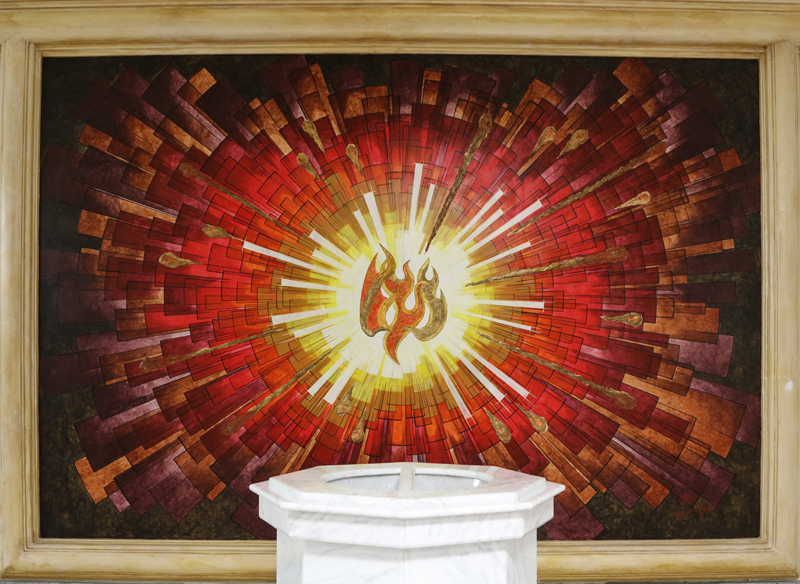
This sermon was given on the observance of the feast of All Saints (transferred) and on the occasion of the baptism of an adult. The readings of the day can be found here, but the content of this sermon focuses on the occasion itself.
I recently heard a friend and colleague recounting her memory of her first child’s baptism. She was 6 weeks postpartum, she and her husband were sleep deprived, and she had not been an Episcopalian very long. They presented their six-week-old baby with trembling hearts and tearful eyes, overwhelmed by the magnitude of the promises they were making. She said that she remembers thinking “What am I doing? How can I possibly do this?” And then the voices around her swelled to join her voice in the response “I will with God’s help.” A promise not made in isolation but grounded in community and honest about our need for God’s help to live up to our commitments. She held her baby in her arms and in turn the Church held her, God held her, giving her strength in her weakness and courage to outlast her fear. It is the role of the church in the life of every family who brings a member to the font. A safety net, a firm foundation, a strength surrounding them in moments of pain, fear, and failure. The baptismal promises that parents and godparents make on behalf of their children are made with the knowledge that everyone witnessing those promises is remaking their own. When those promises have been made, when a little one is baptized into the church, loneliness might still find them, but they will never have to be alone again.
Most of this is the same, regardless of the age of the person being baptized. The promises are the same, the liturgy is the same, the water and the chrism are the same. But unlike the infant, who is meeting the church for the first time, or the young child who has only known the church in part, adults seeking baptism know exactly what the church can be- the good, the bad, the ugly. Very often, adults seeking baptism have spent a while with the church before the water meets their forehead. Adults approaching the font know that the institution of the church is not perfect. Adults joining a new church understand this too. They know that people are still people, whether in the street or in the pews. They know that hurt, and conflict, and grief are natural byproducts of living in community. They know that no group project is perfect, and no congregation is of one mind, whatever they might claim. An adult who enters the waters of baptism does so with eyes wide open, with the full knowledge that the world is still the world on the other side. And yet they make the commitment anyway, with a stubborn hope in the promises of God.
All Saints Day, one of the traditional occasions for baptism, is the day the Church remembers all those who came before, the baptized who have moved from glory into glory through the gate of death. There are many definitions of sainthood, and I won’t get into the semantics and the history or we’d run out of time for our birthday lunch. But the earliest uses of the word saint to describe Christians is in Paul’s letters and in the Book of Acts. In both cases, the word saint is applied to anyone who is a baptized and faithful believer in Jesus. Over time, it began to be applied specifically to those faithful baptized who had died. As my campus minister liked to put it, “all you have to do to become a saint is be baptized, then die.” Now, we all hope that second part comes in the far distant future. But in keeping with scripture, it is entirely appropriate to call every baptized person in this room a saint. The moment the water touches a person’s forehead and the strong name of the Trinity is invoked, their journey of sainthood begins.
It’s true! Every person in this room is a saint, or at least a saint-to-be. Every person who has passed through the waters of baptism has been sanctified by the same Holy Spirit that moved over the waters at the beginning of creation and appeared as tongues of flame over the apostles at Pentecost. Every one of us is a saint, and that means that saints aren’t the perfect, holier-than-thou people we have been led to believe. It means the saints of old were not sinless, golden-haloed people who never messed up, never sinned, never hurt someone or did something they regretted. It means they’re people, just like each of us, and that means each of us has the capacity to be like them. The saints in the stained-glass windows and legends doubted, and fought, and got angry, and felt depressed, and cursed and drank and made messes. They made mistakes, they argued with each other, they hurt each other’s feelings. And through the Grace of God and the gift of the church, they kept the faith and found a way forward together. They stayed in community, even when it was hard, and they invited new people in even when it meant change would come with them. They kept their commitments to the Gospel and to one another, and it is because of their efforts that we inherit the faith we have in Jesus.
As we renew our baptismal commitments, I hope you’ll pay close attention to the words. What we have in our baptismal promises is an outline for the life of a saint. We have the creed, our shared beliefs that we inherit from generations past. We have the spiritual practices that ground us, the teaching and fellowship, the breaking of the bread and the prayers. We commit ourselves to perseverance, to resisting evil. Whenever we fall into sin- not if, but when, because we are human even in sainthood- we promise to repent, to return to God and the community. We promise to be evangelists, proclaiming by our words and our actions the Good News of God in Christ. We commit ourselves to the commandments of Jesus, to loving our neighbor and ourselves, striving for justice and peace and dignity and respect. And through it all we say “I will, with God’s help.” I will, but not alone. I will, but not perfectly. This is what it is to be a saint. An imperfect person, imperfectly striving to love like Jesus. This is what it is to be the church, a bunch of imperfect people trying to keep these promises together and holding each other up when the burdens of sainthood are too heavy. By God’s grace and often in spite of ourselves, we are all saints. Sainthood isn’t easy, but with God’s help and the faith of our church, we can, and we will.
 Mother A Writes