Matthew 1:18-25
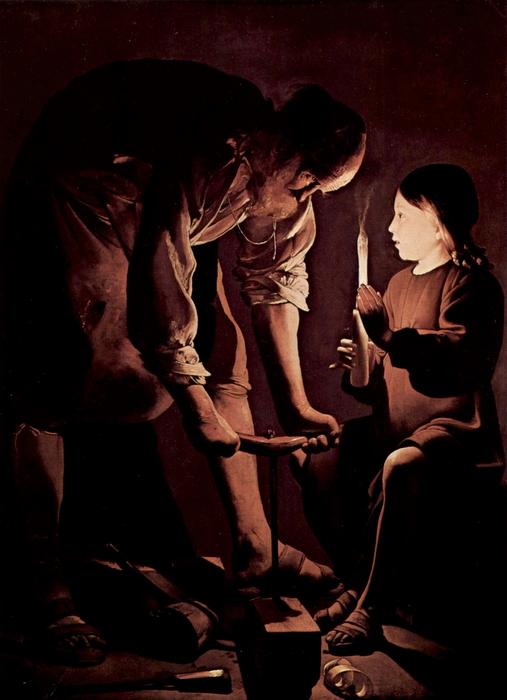
I have always felt a tenderness toward Mary’s husband. I find it fascinating that history remembers his name and his occupation, but none of his words. Joseph, the patriarch of the Holy Family, does not have a single line of dialogue in the Bible. Like Zechariah, who was silenced by God for nine months until the birth of his miraculously conceived son John restored his voice, Joseph’s role is a quiet one. He is a supporting character in the story of salvation, and what Matthew remembers of him can be summed up in less than a dozen verses in the first two chapters of his Gospel. Joseph is righteous, he is compassionate enough to take Mary’s safety into consideration when deciding how to disentangle himself, and he is a dreamer. Three times, Joseph receives a message from an angel of the Lord in his dreams, and three times he does as the Lord commands him. Each time, the command is about protection. First, Joseph is commanded to take the pregnant Mary as his wife and to give her son a name and a home. Second, Joseph is commanded to flee with Mary and her young child to Egypt to protect Jesus from state violence. Third, in a scene that is not depicted in scripture, Joseph receives the promised message from the angel that it is safe to return to Nazareth and make a home for Mary and Jesus there. It is for this reason that the Church remembers Joseph as faithful protector, guardian, defender, nurturer, and patron. He spent the rest of his life protecting the precious treasure entrusted to him by God and by Mary, a task that scripture shows us again and again was neither simple nor easy.
So why Joseph? We could spend hours contemplating why Mary was chosen to carry the incarnation in her body, and the Church has spent centuries reflecting and researching and arguing and debating the qualities that made her fit for such a task. Plenty of discussion has been had about Joseph, although overall I think much less ink has been used on the subject. His righteousness may be the reason God called him, or his demeanor, or maybe he was simply in the right relationship at the right time, his fate swept up in Mary’s call. I am sure that many clergy spouses can attest to that particular sensation, and how often the calling of one spouse unfolds into a calling of both spouses to particular ministries in a particular community. We do not really know, because the evangelists did not record the particulars of Joseph’s personality and he appears not to have lived long enough to see Jesus become an adult. What we do know about Joseph, scarce as that knowledge may be, teaches us something about calling, and power, and the nature of God.
In the time and place and culture into which Jesus was to be born, power was determined by a complex constellation of factors including gender, ethnicity, birth order, trade, and lineage. Zechariah, a priest, held that role because he was a man born of a particular lineage that could be traced back to the first keepers of the ark of the covenant. Joseph is a descendant of David, but this has not translated into a specific vocation. Joseph, very likely following in the footsteps of his own father, was a carpenter, a tradesperson who worked with his hands to build and create. As a man with a trade, Joseph was what we might think of as working class, able to provide for himself and a small family a modest living. We know their life was modest because when they gave a thank offering in the Temple after Jesus’s birth, they presented two pigeons, the lowest tier in the sliding scale of Temple sacrifices. Still, as a man and a head of household, Joseph was in a position of power in relation to others. He had more power than Mary, who was a woman and unmarried. He had more power than children like Jesus, who were subject to their parents and teachers. Of course, they all had less power than the Roman occupying forces or the puppet kings appointed by the Empire or the tax collectors that ensured economic dominance for Rome. But in his little corner of the world, in his sphere of influence, Joseph had power, and he shows us who he is by how he chose to wield that power.
When Mary became pregnant, Joseph could have made a scene. He could have demanded a divorce and renumeration from Mary’s family for the insult. He could have humiliated her and put her safety and the safety of her unborn child at risk by making the pregnancy a public spectacle. Plenty of men in today’s world do far worse for far smaller perceived slights from the women in their lives. Joseph knew this, knew the power he held and the danger Mary was in, and decided to go a different route. He planned to dismiss her quietly, which we are told is a fruit of his righteousness. But in doing so, however noble his intentions, Joseph would still have put Mary at risk this way. Her condition could not be hidden forever, and every day that she was unwed was a day closer to public disgrace of another sort. Joseph’s intentions may have been righteous, but the impact of such a dismissal would have been catastrophic for the woman God chose to bear the Messiah.
God was not impressed with Joseph’s plan. The protection of Joseph’s social, cultural, and economic power was necessary for the safety of Mary and her son, and God was not going to let Joseph get away with doing the bare minimum. Through the message of the angel, God called Joseph to a ministry that recognized his position and his privilege and wielded both for the safety and peace of vulnerable people. God challenged Joseph to cede the power he assumed he would have over his wife’s body and reproduction, to see Mary as more than just a vessel for his own ends. God, the only source of true power, demonstrated that power through the creation of a new life in a new way. God laid that fragile new life in the arms of Joseph, empowering him to enter fully into the story instead of remaining a background character. When the forces of evil and empire threatened that precious child, God empowered Joseph to gather him up and take him to safety, building a temporary home and creating normalcy even in the terror of life as refugees. When it was safe to return, Joseph taught Jesus the family trade, ensuring he would always have a way to provide for himself and for his beloved mother. In every way available to him, even when it was countercultural, Joseph answered the call of God. He did this by loving his family and wielding his power for them, not over them, acting as their protector but never their master.
Like Joseph, we all face moments when the balance of power and privilege tips in our favor at the expense of others. Like Joseph, we all inherit roles and expectations based on our lineage and our gender and where and how we were raised. And like Joseph, God calls each of us to take stock of these realities so that we might better love and serve those people God entrusts to our care, whether they be our family by blood or choice or circumstance. Every one of us has the power to impact someone more vulnerable than ourselves through our choices, through our words and our actions and the actions we choose not to take. Will we protect them, or will we protect ourselves at their expense as Joseph was tempted to do? Will we hear God’s invitation to step into the salvation story, to be a supporting role in building the promised kingdom? We may not all feel called to be Mary, or Peter, or Paul. But we could all be a little more like Joseph, quietly setting aside our egos to make room for the son of God.
 Mother A Writes