Luke 2:1-14(15-20)
We want a big God. We want a God who will stop wars and move mountains and slow the passage of time. When we feel small and afraid in the wide world, we want a God who is bigger than us to protect us and fight for us. When we encounter natural marvels like our own mountains and valleys, like the Grand Canyon or Denali or the Atlantic Ocean or the Milky Way Galaxy, we can’t help but to think of the massiveness of God. Since the earliest days of human history, we have wanted a God who goes out ahead of us into battle and always prevails. When the ways of this world are too hard to bear, when the powers and principalities drive us to despair, we want a God who comes thundering down from on high to set all things right. We want a big God, and that is what we have. We have that God, and we have seen the big ways that God has worked in the world through human beings and angels and the magnificence of all creation. Our God is unfathomable, larger than anything our human imaginations can muster, so overwhelming that just a glimpse of God’s full glory could transfigure us forever.
The bigness of God fits our understanding of power, the framework on which so many of our assumptions hang. Before anyone ever uttered the phrase “survival of the fittest,” we had already accepted that survival of the biggest is true most of the time. In a conflict between two animals, the bigger one will win. In a conflict between two armies, the bigger one will win. In a conflict between two people, the bigger one will win. In a conflict between two minds, the bigger one will win. In a clash of religions, our God is bigger, and so our God wins. This assumption has led to conquest, colonization, enslavement, and oppression in the name of God, and continues to define entire movements within Christianity. But God has already refuted this assumption. God has already shown us, again and again, that might does not always make right. In the nativity of Jesus, God teaches us that some of the most powerful things in the world are very small indeed.
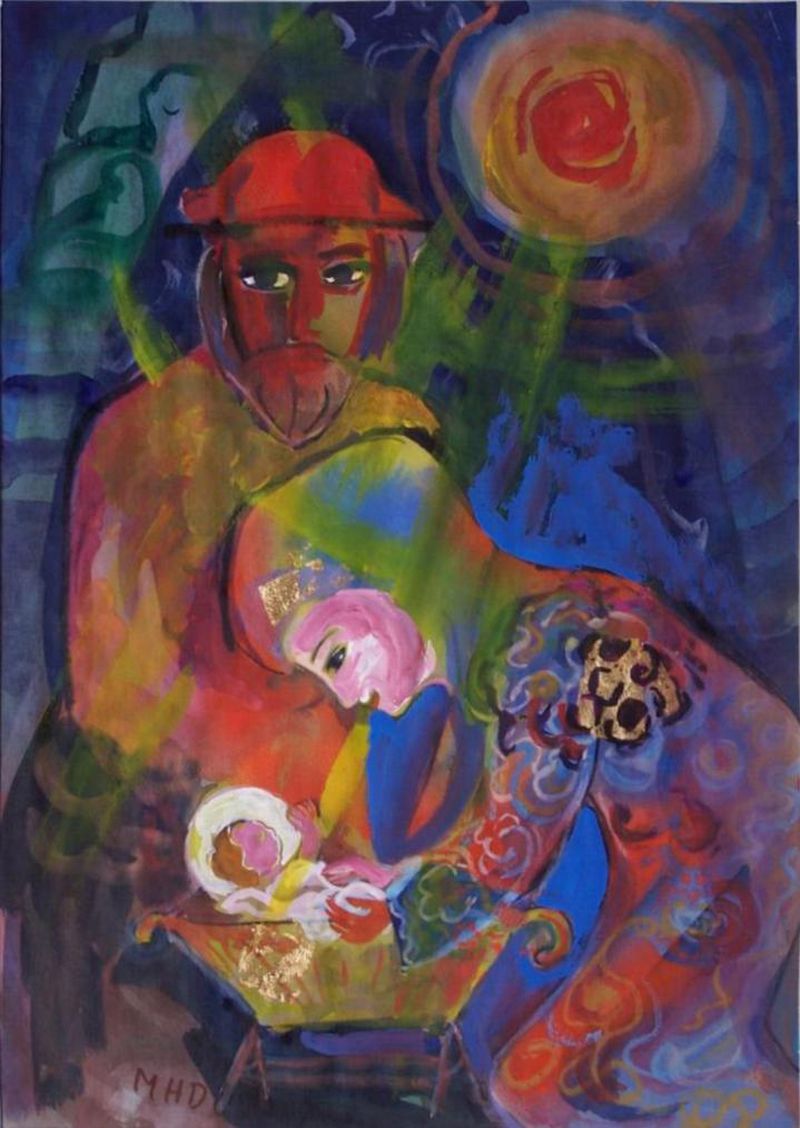
Two thousand some odd years ago, a young woman gave birth far from home, surrounded by strangers and distant relatives of her husband. There was no room for this growing family in the guest room, so they got as comfortable as they could in the space where the animals slept. That young woman wrapped her tiny newborn infant in swaddling clothes to mimic the safety and warmth of her womb, easing her son’s transition into a world apart from her. As all the hymns and carols and paintings and creches depict, Mary laid tiny Jesus in the manger, kicking up the sweet earthy scent of hay. Exhausted from the hard work of being born, the newest little human rustles a bit before falling asleep. Like all new parents, Mary and Joseph watched anxiously for the movement of his deep breaths, until Mary herself gave in to the exhaustion and fell asleep, leaving Joseph to watch over his entire world through the night. I can only imagine how they marveled, as if one of the great wonders of the world lay in that manger. Even knowing all that they did, even having encountered angels, I wonder if they were truly able to distinguish the real presence of divinity from the everyday awe of parenthood.
In Jesus, in the incarnation, in God with us in human flesh, God is the smallest God has ever been or will ever be again. In the incarnation, God has submitted to being microscopic, infinitesimal. Our big God who made heaven and earth and the ocean and the Milky Way was so small that he needed the body of his mother in order to survive. The God who parted the sea and freed the Hebrews from enslavement in Egypt became small enough to swaddle, small enough that it took his entire hand to hold Joseph’s pinky finger. The God who made us became small enough to be held by us, fed by us, clothed by us. The God who created us became small enough to need us.
And because God chose to come into the world as someone small, we know beyond a doubt that there is no one who is too small for God. There is no person, no prayer, no concern too small for the God who has been smaller than a grain of sand. And there is no human being that is too small to bear God’s image. There is no one too small or insignificant or controversial to bear the Gospel, because the Word himself was born to an unwed Jewish woman in a stable in a backwater town under foreign occupation. The most powerful force, the source of all that was and is and is to come, had the tender skin and fragile bones and short patience of a newborn, and because of this we know that power belongs to the tender and the fragile and the small. Love is big, bigger than anything else that might try to overshadow it. And that big love knows what it is to feel small. So let us come closer, to see this tiny person who has changed the world. Let us be reminded that big Love is often found in small and unexpected places. Let heaven and nature sing.
 Mother A Writes