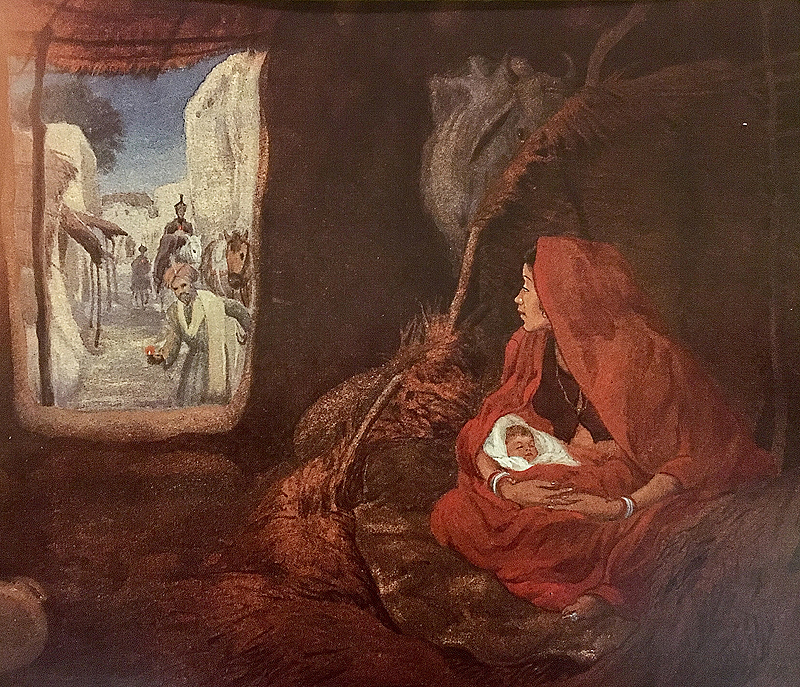
Matthew 2:1-12
When I was a teenager, I was cast one year as one of the three wise men along with two of my classmates. We had all aged out of being sheep and shepherds and angels, and we weren’t quite old enough yet to play Mary or Joseph or the angel Gabriel, although by the time we graduated high school we had all taken a turn in the angel wings and the Holy Family costumes. As the magi, we were dressed in magentas and purples and golds and optional, comically bad fake beards. The stage directions were very clear that we were to each come forward up the long aisle in time with one of the verses of the hymn We Three Kings. It was a familiar hymn, and I remember especially loving when one of the professional singers in our choir sang the verses as a solo in his beautiful baritone voice. But I had never paid close attention to the words until those hours of rehearsals for the pageant gave me the chance to hear them over and over again. As we consider this passage from the Gospel according to Matthew today, I am reminded of what struck me about the hymn all those years ago.
We three kings of Orient are,
bearing gifts we traverse afar,
field and fountain,
moor and mountain,
following yonder star.
Born a King on Bethlehem’s plain,
gold I bring to crown him again,
King for ever,
ceasing never
over us all to reign. [Refrain]
Frankincense to offer have I:
incense owns a Deity nigh;
prayer and praising,
gladly raising,
worship him, God Most High.
Myrrh is mine; its bitter perfume
breathes a life of gathering gloom;
sorrowing, sighing,
bleeding, dying,
sealed in the stone-cold tomb.
Glorious now behold him arise,
King and God and Sacrifice;
heaven sings alleluia:
alleluia
the earth replies.
Setting aside for a moment the assumptions and outdated language around Asia that are embedded in most of our art about these wise ones, what do we actually know about them? Matthew tells us that they are wise men from the East. But east of where, exactly? These words were written far before the land in which these events took place was known as the Middle East. There was not yet a concept of Near and Far East, both of which are terms relative to the colonial powers of Europe that would rise centuries later. We often assume that these people came from somewhere on the Asian continent, but even that is an assumption based on geopolitical and geological concepts that looked very different at the time. So really, all we know is that they came from somewhere far away, somewhere culturally and possibly ethnically different from the majority-Jewish city of Jerusalem under Herod. They came because of something they observed in the sky, a kind of astrological interpretation that was viewed with suspicion by strictly observant Jews but, just as horoscopes continue to transfix many of us today, there was always a market for divination and fortune-telling. Based on their behavior, it seems unlikely these were fortune-tellers for hire. More likely, they were Zoroastrians, one of the oldest organized religions on the planet, and they discovered the star during their regular religious practice of interpreting the stars and planets.
I find that so striking. These people, who do not follow the God of Israel or belong to the Covenant with Abraham, practitioners of a faith that was entirely different from that of Mary and Joseph, are among the first to meet Jesus. As the hymn dramatizes, they have travelled far through rugged terrain and overcome many obstacles. They have managed to arrive to their destination with goods of great value still in their possession, a difficult task when bandits and Roman soldiers both patrolled the roads. They have risked their lives and their fortunes to reach where the star has led them, and they risk even more by leaving again without reporting back to the violent and jealous Herod. They did not make this journey intending to become pilgrims on a camino, nor as converts to an as-yet-unnamed faith. They saw a star, and they followed it, and where it led they found a mother and a child.
We imagine that there were three of them, although that is not specified anywhere in the Bible. Their gifts come in three categories; gold, frankincense, and myrrh, but their number may have been much larger to carry it all across such a distance. As our hymn illustrates, these three gifts are rich with symbolism and meaning. Gold, for the adornment of a king. Frankincense, to offer up to God in worship. And myrrh, the fragrant funerary oil used to embalm bodies for burial. Any one of these gifts would have been extravagant, and all three combined was likely more wealth than Mary or Joseph had ever seen in their lives.
We do not witness a miraculous conversion of these astrologers from afar. We are not told that they convert to Judaism, or become god-fearers, or that they someday accept Jesus into their hearts. The Biblical authors are seemingly unconcerned with the salvation of these gentiles who interpret stars and dreams. Mary does not proselytize; Joseph does not ask them to sit down for coffee so that he can convince them to say some magic words that will save them. The anxiety that some modern Christians have for the souls of the practitioners of other religions is entirely missing from this story. In fact, it is by practicing their own religious and cultural traditions that the wise men discover the star and understand its meaning. It is by doing what their culture expects of them that they meet God in the flesh. And as the angels said to certain poor shepherds in fields as they lay keeping their sheep – the birth of Jesus is good news of great joy for ALL the people. If what we preach is not good news for the magi, if it is not good news for the refugee family fleeing persecution at the hands of a violent regime, if it is not good news for the poor shepherds and their sheep, it is not the Gospel.
Every time we are tempted to division, the Gospel shows us unity. Every time we are tempted to exclusivity, the Gospel shows us radical inclusivity. Every time we are tempted to despair, the Gospel shows us the big and small actions of love done by big and small people. The gifts of the magi are of great material value, but the sacrificial offering of their journey is even more precious. These wise ones from a far land show us that God is already working in every place and every people, and that people who are not Christian can still hear the call of God and point us back to Jesus with their lives. We do not own God, we do not have sole entitlement to God’s story or God’s grace. We can learn about our own faith through the faithfulness of others, even when those others look and speak and pray very differently from us.
The incarnation, the enfleshment, the advent of the Light of the World, the nativity of God With Us is Good News for all the people.
O star of wonder, star of night, star with royal beauty bright; westward leading, still proceeding, guide us all to thy perfect light.
 Mother A Writes
This was so well written Alluson! It’s very insightful and sensitive. I especially liked the third from the last paragraph… “people who are not Christian can still hear the call…We do not have sole entitlement to God’s story…”
Well said!
Thank you! I so enjoyed reading this.
Nancy Johnson
LikeLike