Isaiah 58:1-12
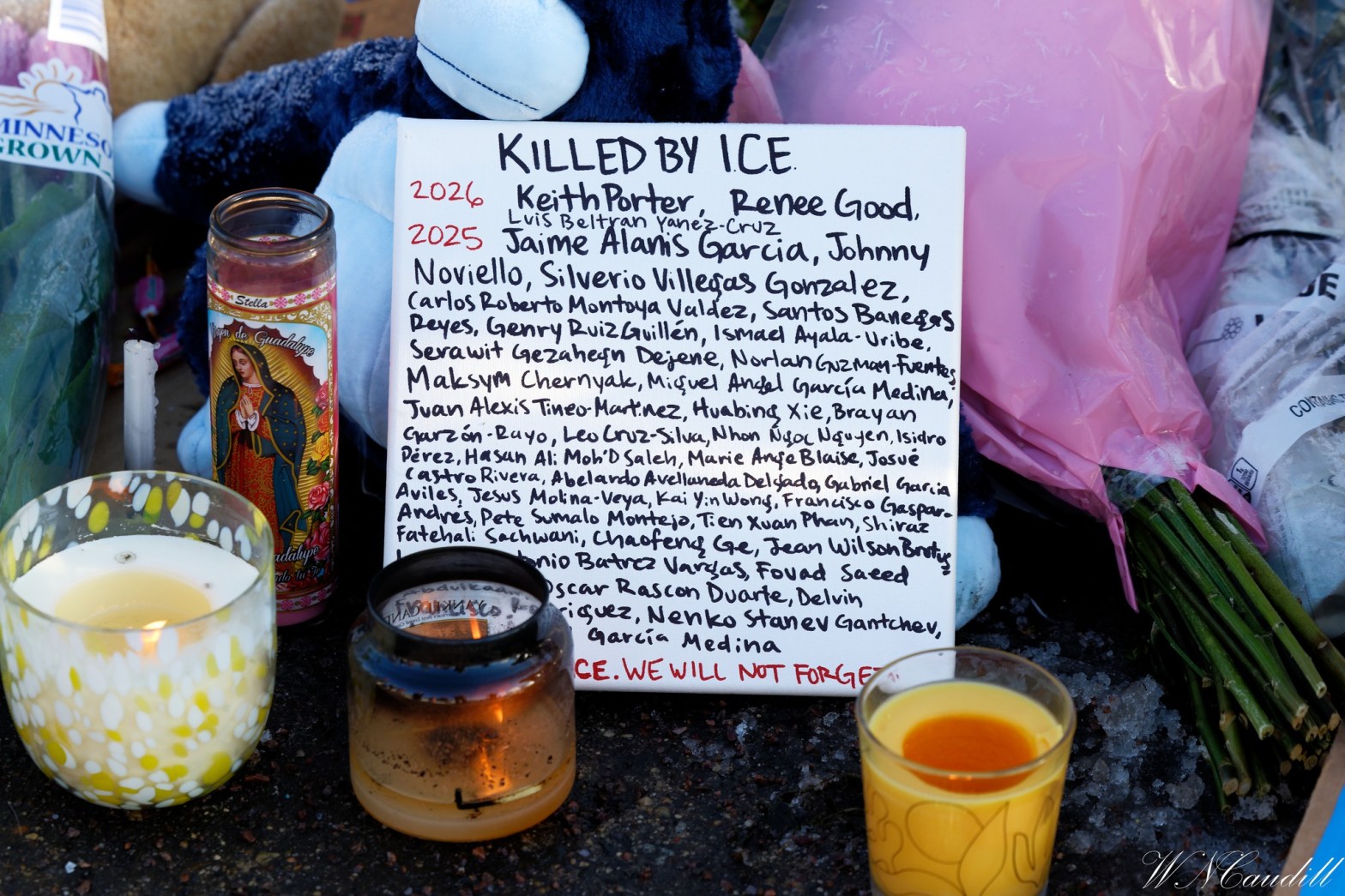
The photo associated with this post was taken by my father, William N Caudill, at the Minneapolis memorial the community has constructed at the site of Renee Good’s killing at the hands of an ICE agent. The photos were taken on 1/12/26, prior to the killing of Alex Pretti. The protest songs referenced in this sermon are published by Annie Schlaefer and can be found here. I am indebted to the resistance songleading work of people like Annie Schlaefer and encourage you to learn more about the ICE OUT SING-IN resistance practices here. The Resistance Revival Chorus has a great short video about the history of protest music here. “When the movement is strong, the music is strong.” – Harry Belafonte
Part of me was very tempted to simply reread our Isaiah passage in its entirety. Every single line would be worth repeating, worth hearing again and again. Every time this passage comes up in the lectionary, it somehow manages to speak directly to whatever horrors the powers of sin and death have wrought most recently, a clarion call to the faithful.
If you can hear this passage and not think of a headline from the past month, I hope you will read it again more closely. I hope you will listen. I hope we will all listen, and hear, and understand. We humans have been failing in the same ways, falling into the same patterns of sin, for as long as we can remember. Evil is entirely unimaginative, always destructive and never creative. Evil does not invent, it only appropriates and reinvents itself. We have been here before. We have fallen short in this way before. And so a message from a prophet speaking in an ancient language to a people who lived and died nearly a millennium before the birth of Christ is timely, and relevant, and convicting in the year of our Lord 2026. The Word of the Lord is the same for us as it was for the people who first received it from Isaiah.
There is no room for misunderstanding in this Word from the Lord. Loose the bonds of injustice. Let the oppressed go free. Share your bread with the hungry. House the homeless. Clothe and shelter the naked. Remove the finger-pointing and the evil speech. Satisfy the needs of the afflicted. If you do these things, you shall be called the repairer of the breach, the restorer of streets to live in.
A couple of songs have been stuck in my head for the last week, ones that moved me to tears the first time I heard them while scrolling through my friends’ videos from protests outside of ICE detention centers. They are both short songs, meant to be sung to the perpetrators of injustice and oppression. I do not know the religious convictions of the person who wrote or shared the songs, but they are for me a perfect encapsulation of the Christian call to repentance.
“It’s okay to change your mind, show us your courage, leave this behind. Oh, it’s okay to change your mind, you can join us, join us here any time.”
“We walk the same ground, but we’ve been torn apart. Put down your weapons, come sing your part.”
The people who were singing these were singing them to agents of the state, including ICE officers and the politicians and officials giving their orders. Unlike the equally impactful hymns of rage and chants of defiance that can be heard at any protest, these songs and others like them act as an invitation, an offering of compassion and welcome. You can join us here any time, the people sing.
You who have been told that there is only one kind of power that counts, put down your weapons, come sing your part.
You who have been trained to see some human beings as inherently threatening, show us your courage, leave this behind.
You who have been on record for years or decades in favor of the policies that have led us to this moment, it’s okay to change your mind.
You who have caused harm, you who have instilled terror, you who are so engulfed in shame and fear that you only feel safe when you hide your face, show us your courage, leave this behind.
We walk the same ground, but we’ve been torn apart.
This is not vengeance. This is not punishment. This is not even shame. This is the call of the baptizer, pleading the people to repent, for the kingdom of heaven is at hand. This is the sermon on the mount, the loaves and fishes, this is Jesus breaking bread and praying with the friends who will betray and abandon him, giving them yet another opportunity to choose differently. This is Paul, begging the churches in Rome and Corinth and Ephesus and Colossae to turn away from the systems that had taught them that God would show partiality, and to understand instead that there is no longer any separation between them. It’s okay to change your mind. You can join us here any time. This is the gospel.
I have always been particularly struck by the end of this passage from Isaiah, the part that sometimes gets left off for brevity’s sake. Your ancient ruins shall be rebuilt; you shall raise up the foundations of many generations; you shall be called the repairer of the breach, the restorer of streets to live in. I wonder what it really means to be called a repairer of the breach. In the context of these few verses, it could be interpreted quite literally as a person who repairs broken places, who repairs streets and rebuilds neighborhoods and cities that have been breached by violence and invasion. But in the larger context of the fast that God chooses, the way God’s people are called to live, it might be a little more complicated.
The breach we are called to repair is not one that can be repaired with lumber and concrete and hammers and nails, at least not only with those things. The breach is a chasm between what is and what could be, between what is done on earth and what is the will of heaven. Where there is enough food and still people starve, there is a breach. Where there are vacant buildings and empty homes and still people sleep on the steps of churches and in tents under overpasses, there is a breach. Where the most highly trained doctors and nurses and most state-of-the-art medical facilities exist and still people die of treatable and preventable diseases, there is a breach. Where there is more than enough room, where there are more than enough jobs and more than enough resources and still the doors are slammed shut on those who seek to build a better life, there is a breach. Where people suffer and die because of the color of their skin or the land where they were born, there is a breach. Where people die in the street while looking out for their neighbors, there is a breach. Where people fear for their lives and the lives of their children, there is a breach.
The trouble is, we have to actually want to repair the breach. We have to want the oppressors to change their minds. We have to want the people we don’t like to amend their lives and start anew. We have to want them to join us, to labor alongside us in the vineyard of the moral universe. And we have to be willing to change our own minds. We have to be willing to admit when what we used to believe is no longer holding up in the light of the Gospel. We have to be willing to listen when the prophets and martyrs speak. We have to be willing to be wrong, and to do something about it. We have to be willing to change our minds, and we have to be willing to welcome others when they change theirs. Otherwise, we are simply serving our own interest, quarreling and fighting and wondering why it seems as if the voice of God has gone silent.
“We walk the same ground, but we’ve been torn apart. Put down your weapons, come sing your part.”
Is not this the fast that I choose: to loose the bonds of injustice, to undo the thongs of the yoke, to let the oppressed go free, and to break every yoke?
“It’s okay to change your mind, show us your courage, leave this behind. Oh, it’s okay to change your mind, you can join us, join us here any time”
Let your light shine before others, so that they may see your good works and give glory to your Father in heaven.
You are the light of the world. You shall be called the repairer of the breach. For the love of God, let it be so. Amen.
 Mother A Writes