Matthew 17:1-9
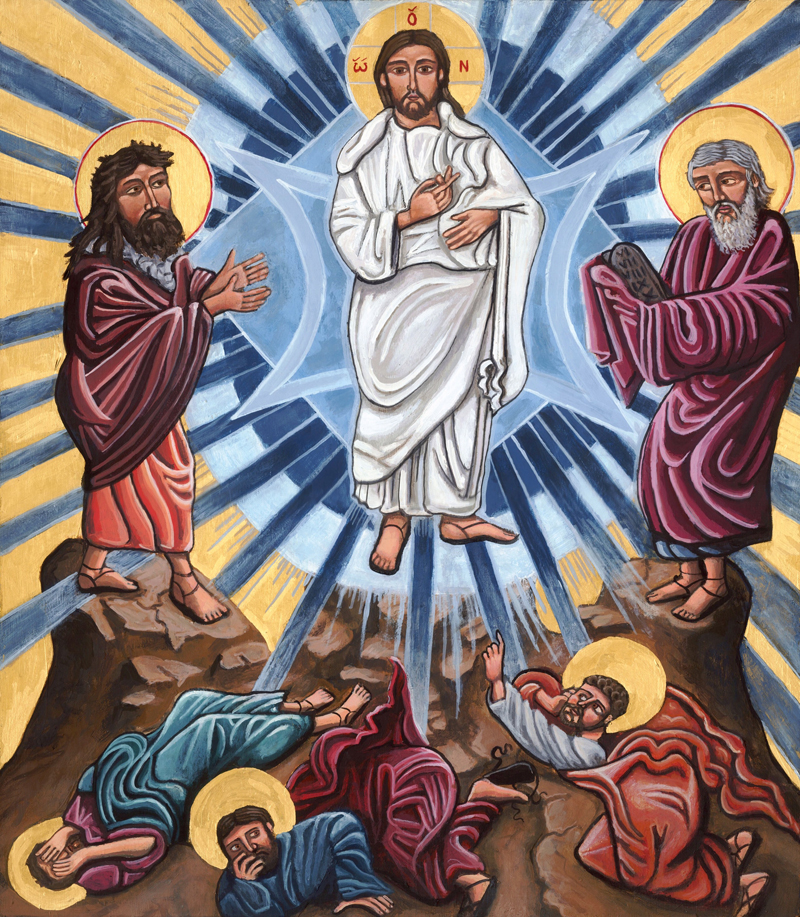
In many of the traditional icons that depict the Transfiguration of Jesus on the mountaintop, the poor disciples are either face down on the ground or laid out on their stomachs or backs with looks of pure panic on their faces. The juxtaposition of serene Jesus, Moses, and Elijah with freaked out Peter, James, and John is almost comical, as if the reaction of the disciples is overdramatic, even theatrical. Jesus is dressed in white of course, and the heroes of the faith on either side of him usually have serene looks on their bearded faces. Sometimes there are wisps of cloud creeping in on either side of the image, hinting at the dense cloud that temporarily engulfs and isolates the disciples and from which the voice of God speaks to them. It is a difficult scene to capture, especially since so much of the action challenges the eye. The light shining from Jesus is so bright it is dazzling, maybe even dangerous to look at for too long like the sun to which he is compared. That dazzling light is replaced by a cloud, blocking the disciples’ vision entirely. This story is as much about what cannot be seen as what is seen on the mountaintop.
If I were gifted in the art form of iconography, I would be very interested in depicting what comes next, what happens after the clouds have parted and the light of heaven has dimmed and Jesus’s clothes return to their dusty, travel-worn normal. After the echoes of the booming voice from on high have ceased, and the otherworldly presence of long-dead heroes has faded into another impossible story. The moment Jesus reaches down and touches them with the calloused hands of a carpenter, pulling them to their feet and banishing their fear. To me, it is that simple human act, that relational moment, that shines just as brightly as the transfiguration. The moment Jesus placed a hand on the shoulder of a friend in distress and told him “Do not be afraid.”
Throughout scripture, God appears to God’s people in many forms – a voice, a cloud, a pillar of fire, a stunning silence, a burning bush, a dove, a glorious light. Sometimes the people have a direct conversation with God’s voice, like Job or Jonah. Sometimes the people receive the Word of God secondhand, through prophets to whom God appears in visions and dreams heavy with symbolism and meaning. Sometimes God sends angels to intercede, providing a sometimes necessary degree of separation for people to receive and process what is being shared with them. God appears through miracles and births and sometimes in the desert and sometimes on the altar and sometimes in the tabernacle. Throughout the Old Testament we see witnesses of God’s self-revelation describe the overwhelming, overpowering, awesome and awful presence of the glory of the Lord.
On that mountaintop, God’s glory was revealed once again in a bright light and a loud voice and an enfolding cloud. But then, just as unbelievably, God’s glory was revealed in the touch of a human hand, the gentle cajoling of a human voice, an invitation to get up and leave fear behind from a friend.
The hand on the shoulder. The quiet after the storm. The divine connection of human touch. This is the piece of the transfiguration that is rarely if ever depicted in icons, the part that is often lost in the flash and the dazzle. Throughout all of creation history, God has been revealing Godself to humanity. But in Jesus, for the first time, God reveals Godself AS humanity. God reveals the glory and power and divinity of God in a human body, born of a human body, encountering other human bodies. The transfiguration reveals just how impossible, how revolutionary, how existence-altering and life-affirming the incarnation is. It is that same glory that walks the earth with Peter and James and John, sharing their food and listening to their stories. It is that same dazzling power that inhabits a body that needs sleep and food and quiet time to himself. The same face that shines like the sun on the mountaintop makes jokes at the dinner table with a twinkle in his eye. The transfiguration is most amazing when we remember that all of that light was walking around like you and me for over 30 years beforehand. It is one thing for humanity to surrender to God. It is so much more for God to surrender all that power to be human.
This story is often used to talk about mountaintop moments, the highs of life that make us feel close to God and full of spiritual fervor. By that metric, mountaintop moments are rare, fleeting, and difficult to replicate. But the mountaintop moment ended with God reaching out to offer comfort to a friend who was afraid, lending a hand to help someone up who had fallen down. That kind of mountaintop moment is available to all of us, every day. Every day, we have the opportunity to reach out our hand as Christ reached out to his disciples, raising them up and giving them courage to continue. Every day, there are helpers in the world doing the same for us. Whether we are on the mountaintop or in the valley, we can make the choice to be living icons of Christ. We can choose to let our lives act as mirrors reflecting the dazzling light of heaven into the darkest corners of the world. Because the God of the mountaintop chose to walk with us in the valley, we can walk humbly and with joy. When we fall, and we will, we can get up, because the strong hand of Jesus will be there to lift us up. Listen to Jesus, Beloved, and do not be afraid.
 Mother A Writes