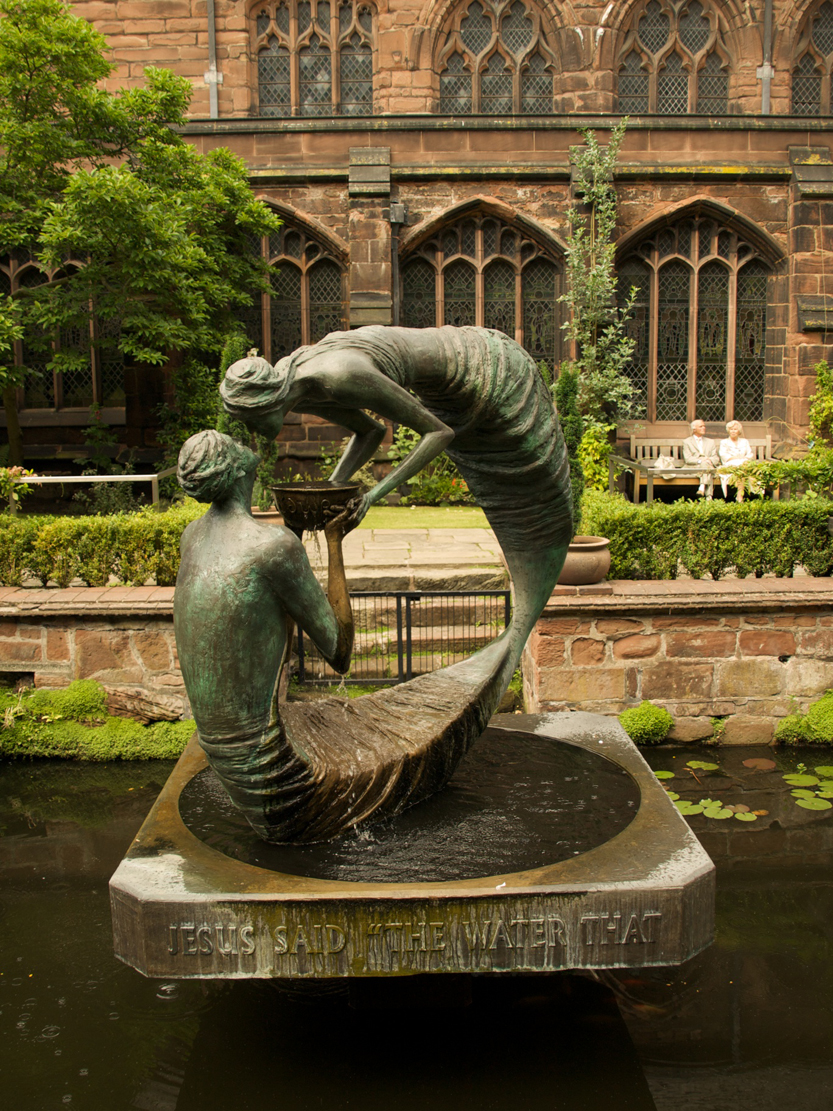
John 4:5-42
Last week, we met Jesus in the night with Nicodemus, a man who was not yet ready to encounter the truth in the light of day. This week, we meet Jesus at high noon, the sun blazing down from above. The teacher is tired and hot and thirsty, so he stops to rest beside the well in town. He does not have a water jar of his own, so he waits for the kindness of a stranger in a land where he is not a welcome guest.
The woman who comes to the well is not expecting to see anyone there, least of all a Jewish man. Drawing water is work most often done by women, a pattern that continues today in places where wells are still the primary water source. With few exceptions, this work is done early in the morning, when the air is still cool and before the majority of the day’s cooking is to be done. It is a communal activity, the village well a watering hole for socializing and gossip as well as quenching thirst. Women share stories, exchange news, offer encouragement and solace to one another as they wait their turn to fill their water jars, often with young children underfoot or strapped to their backs. For a woman to be alone at the well, in the heat of the day, is a sign that something is not right. This is a lonely, isolated person, someone who has reason to avoid the morning rush and all the fellowship and chatter that comes with it. She is vulnerable, and exposed, without the solidarity or comradery of other women, and the timing implies that she has chosen this solitude. This is who Jesus encounters at the well, and I can only imagine that she is not thrilled to see him.
The conversation that ensues is the longest recorded exchange between Jesus and an individual in Scripture. That record is not held by his blessed mother, or by Nicodemus, or Peter, or by Pilate, or the disciple whom Jesus loved. The longest conversation we have between Jesus and another person is with an unnamed woman from Samaria, someone who had to draw her own water and for whatever reason chose to do it at a time when anyone with sense was indoors, out of the heat and harsh light of the noonday sun. Clearly, this conversation was important, so important that it was remembered and retold and written down and passed on to us when so many other conversations were not.
Jesus and the woman at the well have a fascinating exchange about the complicated history between their two peoples, about the theological differences that separate them and the ancestors that connect them. Jesus offers her living water, and she astutely points out that he is woefully unprepared to draw from the well. When he offers her living water a second time, she meets him with humor. “Give me this water, so I can stop coming all the way here every time I get thirsty.”
Then, Jesus makes it personal. He names a hard truth about her life, the likely reason she is alone at the well in the heat of the day. For some preachers, it has been convenient to interpret the woman’s situation as one of promiscuity. She has had five husbands after all, and the man she is with now is not her husband. Obviously, she is some kind of Black Widow or perhaps just a hopeless romantic who can’t settle down. The tawdry scandal is implied but rarely said out loud. This reading casts Jesus as the magnanimous bearer of forgiveness for an undesirable, morally bankrupt woman who is unworthy of his attention or his care. It casts the woman as a sinner to be shamed or at least pitied, as if she has brought her lonely fate upon herself.
That reading forgets some important things about what it was like to be a woman in her time and place. Divorce was possible, yes, but exceedingly rare and almost always initiated by the man. Divorce usually came up when it became clear that fertility issues would prevent a wife from providing sons to her husband, as if this were a failure or flaw deserving of abandonment. If all or even some of this woman’s husbands divorced her, it is indicative not of a character flaw, but of a devastating lifelong struggle with infertility. Hold this prospect up alongside the reality that she is alone at the well, seemingly avoiding the company of other women and their children, and we are faced with a life laced with grief, loss, and loneliness.
The alternative is just as devastating. Five times married, possibly five times widowed. Five times handed off by her family to begin a new life with a man, only to outlive him and return to her parents’ home after preparing his body for burial. Each time, she is a little older and her dowry is a little smaller, and it becomes harder to find a match. The men willing to say yes might become less desirable, perhaps older or less financially stable or more aloof. As the grief compounds with each loss, she becomes more closed off, her shattered heart trying to protect itself from a seemingly guaranteed loss. Finally, after yet another funeral, her parents are no longer living and she has nowhere to go and no one to provide for her. She moves in with a distant relative, or a man who cares for her but has other obligations that prevent him from marrying. Five times a widow, she no longer has the will to go through with another wedding, even if the opportunity were to present itself. Years of traumatic loss and complicated grief have hollowed her out, and she has nothing to spare for the friendly faces and lighthearted gossip of others, so she draws water at a time when everyone is busy with their families and their full lives.
This is who Jesus chooses to sit and talk with. This is who he endures the heat of the day to encounter, even as he is exhausted from traveling and his friends are at the market in search of food. Nicodemus may have come to Jesus under cover of darkness, but Jesus comes to the well to see this woman in the light of day.
The encounter between this woman and Jesus is not remarkable because she is such a great sinner and he is gracious with her in spite of her sins. This encounter is remarkable because Jesus tells her the truth of who he is and she believes him. It is remarkable because, after a lifetime of suffering and loneliness, this woman meets the Lord and realizes that he sees her and knows her and loves her enough to let her see and know him for who he truly is.
Although she is not named in Scripture, the Church remembers the woman at the well in Samaria as Photine. Her name means “enlightened one,” as she is one of the first to receive and comprehend the light of the Gospel and to become an evangelist, immediately going out and telling others of her encounter with the Christ. She is to be remembered not for a painful and complicated relationship history, but for her exuberant belief and her joyful testimony. Photine is a model to be emulated, a story to be repeated so that history might remember the light she carried from that well into the rest of her life. The light of the world has offered us living water. So let us drink deeply, and following in Photine’s footsteps, run and tell the world where to find the spring of eternal life.
 Mother A Writes