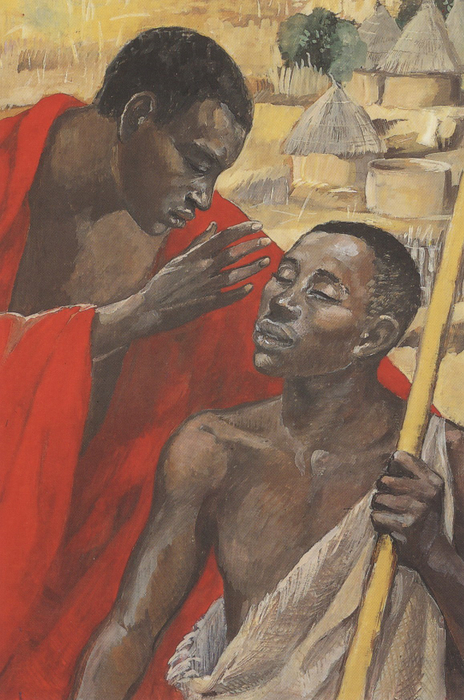
John 9:1-41
For the last two weeks, we have been granted the opportunity to be a fly on the wall of two private conversations between Jesus and two very different individuals. Nicodemus, the well-respected Jewish community leader, comes to Jesus in the night. Photine, the woman at the well in Samaria with a painful and complicated past, receives a visit from Jesus at high noon. In both cases, Jesus engages with the individual as an equal, a conversation partner, and answers their questions and challenges them to ask new ones. Nicodemus and Photine both struggle with what Jesus reveals to them, but ultimately they become witnesses to the Gospel and evangelists to their respective communities. We see in these stories what it really means to have a personal relationship with Jesus. To truly commune with the Living God, to be reborn from above, to receive the living water, involves questions and doubt and change and vulnerability. It is a two-way conversation.
Today, we meet someone new, someone with whom Jesus clearly shared more than a passing connection. Their meeting seems to be one of chance, but of course the Holy Spirit is often at work in moments of serendipity. Jesus sees a blind man, and his disciples try to turn the man into an object lesson. They reduce him down to one part of who he is, his disability, the blindness he was born with. They see this aspect of his life as an unequivocal negative, a problem to solve and a punishment for some congenital sin. Really, they don’t see the person at all, only what they perceive to be missing. Their society makes disability an isolating and extremely limiting reality. There are no Seeing Eye dogs or braille signage or audio aids to help a blind person safely navigate the world independently. Like our own society, the needs of a man born blind or deaf would be at best an inconvenience, an afterthought if those needs were thought of at all. The only financial support available would come from family and from the local synagogue, so the wealthy might manage their disability in relative comfort while the poor and working classes are unable to accommodate or support a disabled family member. The disciples see what society sees; a person whose reality makes them so uncomfortable that they must theologize him in order to engage with him at all.
Jesus does not abide such oversimplification. “He was born blind so that God’s works might be revealed in him.” Not “he was born blind so that God could fix him.” Not “he was born blind because everything happens for a reason.” He was born blind, Jesus tells us, because this man has something to reveal to the world about how God works. His disability is not a problem to be solved, but a site of God’s revelation.
Even after the miraculous healing, people turn the man into an object, a mystery to solve. No amount of the man, remembered by the Church as Celidonius, saying “I am the man” can be heard over the mystified arguing of the neighbors. They do not believe him when he tells them his story. They do not even believe he is who he says he is. Just as is often the case for disabled people today, Celidonius’s own story is not listened to or believed until it is filtered through the experiences of others. His parents are interrogated, his neighbors are questioned, and he is placed on the witness stand more than once before his story is truly heard. The community’s response is to drive him out. In the end, Celidonius never ceases to be a symbol in their eyes, a cautionary tale of the horrors that might await them and their children if they sin or fall short. When he challenges their view, when the objectified disabled person insists on telling his own story and interpreting his own experiences, they are afraid. If he is just as human as they are, if he can encounter God and live to tell the story, if he can offer his own perspective, unimpeded by the ableist system that tries to contain him, then he is now a threat. He is now real; he can no longer be relegated to second-class humanity, his presence can no longer be ignored by simply crossing the street while they pass him by. His presence in their midst is an indictment of the way that they have treated him all along, and they cannot tolerate the conviction for another minute.
The majority of this story takes place apart from the presence of Jesus. He meets Celidonius in the street and offers him a bit of mud and spit and directions to a nearby water source to get cleaned up. From that point on, the action follows the man whose eyes are opened. Celidonius is the main character, after a lifetime of existing in the margins of other peoples’ stories. He is the one who interprets his own healing through the lens of their shared religion, he is the one who makes the bold claim that Jesus must come from God. He says nearly the same phrase that Nicodemus said to Jesus in our passage from two weeks ago. He insists that in order for Jesus to work such a miracle, he must be heaven-sent, because no good can come from anyone who is not doing God’s will.
It is only after Celidonius has been cast out from a community that had reviled him, questioned and accused him, and left him to beg on streetcorners that Jesus returns to the stage. Jesus finds him, and gives him the Gospel, just as Jesus gave the Good News to Nicodemus and to Photine. Jesus reveals his true identity, Son of Man, the one who comes into the world not to condemn but to save it. Celidonius, whose sight has always been clearer than so many people even while he was blind, falls down in worship, because he sees what so many would not. Like Nicodemus and Photine, this man asks Jesus a question, and his heart is open enough to receive the answer when it comes. His blindness and his vision are not the story; his faith is. May our hearts and minds and eyes be opened to receive the Gospel with that same faith, and may our stories be sites of God’s revelation. May we respond to the presence of God the same way Celidonius did. Lord, I believe.
 Mother A Writes