Matthew 21:1-11
While I was away for my second residency of my fellowship, another fellow invited anyone who was interested to come with him into town for coffee and a change of scenery during one of our longer breaks. A few of us took him up on it, and we enjoyed a sunny stroll through the center of town. On our way back to the conference center, the driver asked out of the blue “Would y’all like to see a goat and some donkeys?”
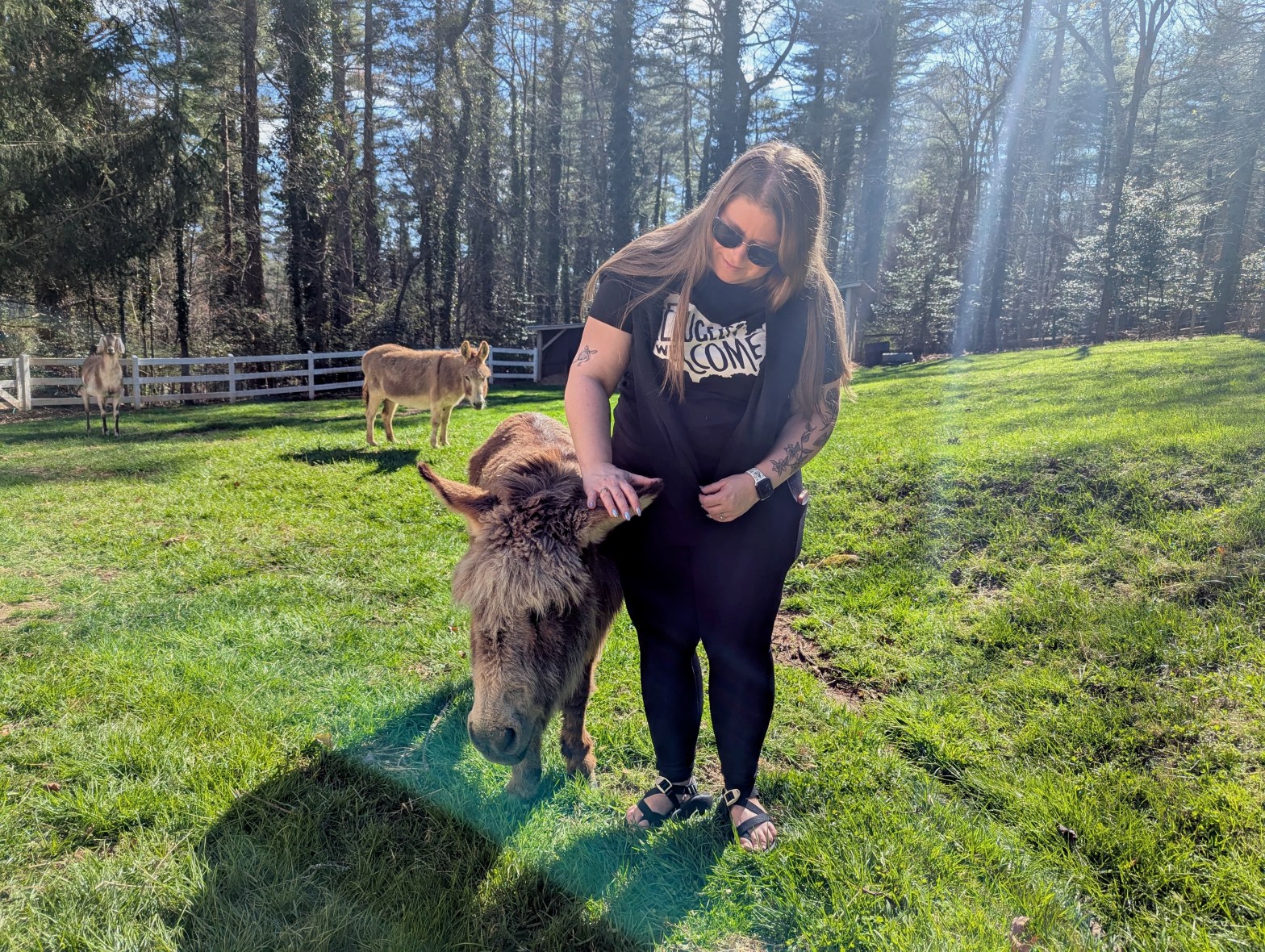
When we got to our colleague’s family farm, we were greeted at the gate by a very friendly goat named Tim, who enjoyed pats and really wanted to nibble on my hair. Further into the field, three small donkeys and another goat eyed us. We learned that Tim could be a bit of an attention-hog, and that the donkeys weren’t likely to come to us for fear of him. While one of my friends kept Tim busy with head scratches, I took a few steps toward the donkeys. Two of them were skittish and trotted off into the shady far corner of the field. But one, Jenny, was brave. She came to me slowly, but once we met she was unwilling to leave my side, even following us to the gate and braying after us as we left. She leaned nearly all of her weight against me, like a very large dog, while I patted her side and rubbed her ears. Jenny was sweet, and gentle, and did not seem to care that I had no snacks to offer.
I learned that Jenny is a fairly common and relatively uncreative name for a female donkey, because that is the term for all females of the species. Although this Jenny was likely smaller than most of the donkeys of Jesus’s day and is living in much greater luxury as a doted-on pet at a hobby farm, she has more in common with the creatures that carried Jesus than any modern thoroughbred.
When Jesus rides into Jerusalem surrounded by palm leaves waving and cries of desperation and joy, he does not choose a warhorse, or a chariot, or even a mule. He enters the sacred city astride a Jenny, a female donkey, and her young colt. In Luke’s version of the story, the colt is so young that no one has ridden him yet; he is not yet trained to carry a person on his back, let alone carry a grown man through a raucous crowd. Perhaps this is why Matthew remembers the colt’s mother, the Jenny whose comforting presence accompanied Jesus and his young mount through the chaos.
As I felt the steady weight of Jenny the donkey in that sunny field, I thought of how it might have felt for Jesus to have that same weight to lean on as he began the final walk toward the cross. I thought of the skittish jennies that were too intimidated to come close, and how brave those animals must have been to carry Jesus into the unknown, surrounded by bodies and strange noises and smells. They bore a sacrifice into the very city where animals were sacrificed daily in the Temple, the smell of blood and cooking meat surely discernible on the wind. I wonder if they were afraid, if Jesus felt their anxiety in their breathing and the way they tossed their heads. I wonder if they could sense the mixture of fear and peaceful resolve radiating from Jesus, the quiet eye in the center of a storm set to consume him. I wonder if his touch steadied them.
I don’t mean to anthropomorphize the donkey and her colt. I have no doubt they were only doing what was expected of them, what they were born to do. I only mean to say that by their very nature, they understood Jesus in a way his friends couldn’t yet grasp themselves. By being only what they were, no more, no less, and by doing what God and nature and human ingenuity had formed them to do, these sturdy creatures moved salvation history forward, one hoof step at a time.
The choice of a humble steed is only one way that Jesus subverted the people’s expectations of their messiah. Scholars describe the importance of the timing of his entrance- just before the Passover feast, when sacrificial lambs were being gathered for the ceremonial slaughter and remembrance of liberation. They emphasize the significance of where he entered the city- from the east, like the sunrise, and from the opposite side of the city as Pontius Pilate staged a military parade at the same time from the western gate. While the Empire poured its soldiers into the sacred city, dripping with armor and weapons and power, Jesus and his friends entered unarmed, a small band of weary travelers with barely enough money between them to find lodging and food for the paschal feast. The crowds shouted hosanna, which means save us. With the empire at their backs, Roman swords and shields and crosses at the ready, the people of Jerusalem looked to Jesus and his Jenny and his filthy traveling cloak and calloused feet, and they cried “Save us.”
The story of Palm Sunday, the story of the donkey and the colt and the palms and the hosannas, is often called the triumphal entry. Artists depict it as a moment of great pomp and circumstance, a moment when the glory of heaven is made visible in a man on a donkey. The kind of triumph depicted here is not the triumph of kings and warriors and soldiers. It is not the triumph won by violence or overwhelming force or sheer strength of will. It is the triumph of brave donkeys, and inexperienced colts, and people who look for salvation in nonsensical places. It is the triumph of sacrificial love, the triumph of humility, the triumph of the last and the least and the lost. This triumphal entry precedes the bloody sweat, the crown of thorns, the overwhelming darkness, but it foretells the empty tomb. The sweet hosannas ring around the man and his donkey, not the emperor and his puppets. The glory, laud, and honor do not surround the throne, but the cross. And it is at the foot of this cross that we wait. It is in the sealed tomb that our hosannas rest, until a new dawn breaks.
 Mother A Writes