John 20:1-18
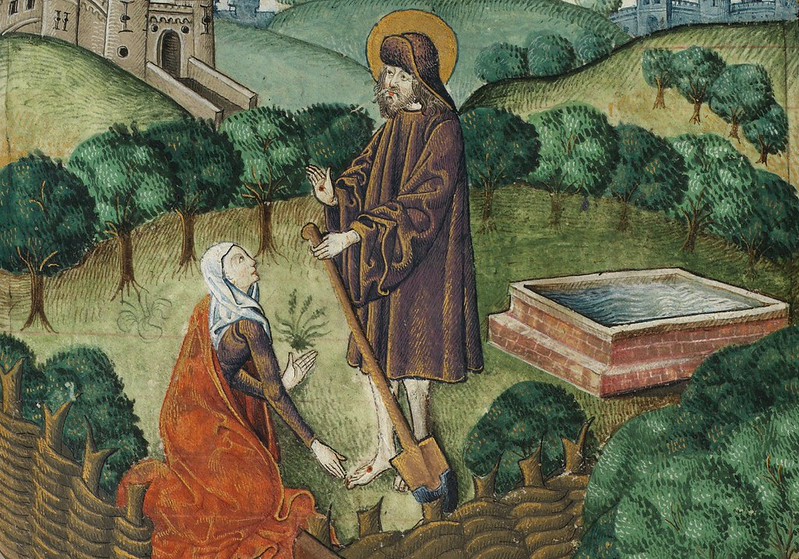
She thought he was the gardener. In her grief and confusion, in her desperation, Mary saw Jesus standing there and mistook him for a stranger, a laborer come to tend the garden where she stood sobbing. I have heard someone speculate that maybe she saw calloused hands with dirt under the fingernails because Jesus had to navigate the soil as he climbed out of his grave. In much of the art depicting this encounter, Jesus is dressed in flowing robes and his skin emits an otherworldly glow. Sometimes he is draped in white, as if the graveclothes he so carefully folded and set aside managed to follow him out of the tomb. My favorite depictions take Mary a little more seriously, assuming she saw SOMETHING that led her to the gardener conclusion. These artists depict Jesus holding a shovel and wearing a wide brimmed hat and simple working clothes. I love these images because they assume that Jesus rose from the dead, rolled up the cloth he had been wrapped in, and got to work tidying and tending the garden around his grave while he waited patiently for his friends to show up. He defeated death and immediately started sowing seeds and tending the new growth that had taken place in his absence.
In so many of Jesus’s parables, he references agriculture. He tells stories of sowers and shepherds and vineyards and harvests. He talks about farmers and field laborers and what it takes for a grain of wheat to become the plant that produces more grain. In a subsistence farming culture, to be a farmer is a full-time job, even for those who also work a trade. To be a gardener, someone who tends to green growing things for their own sake and not for food production, is something entirely different. It is to be a curator, a midwife of the earth’s beauty, plants grown with no purpose except to be seen and smelled and felt. It was in a garden, not a field of wheat, that Jesus said his prayers before he was taken away by the authorities. And it is in a garden, not in a grazing pasture, that Jesus is buried and then raised. It is in a place of beauty, with no other purpose than to be beautiful, that Jesus reemerges from death. Perhaps his first act after bursting forth from the grave was to smell the fragrance of a blooming flower, or to tenderly tuck a seed into the disturbed earth around the tomb. Perhaps he simply sat on the ground and listened to the buzzing and chirping of creatures who recognized him instantly. Perhaps that first happy morning was welcomed by the unfurling of that garden, and every Easter lily and dogwood flower to bloom since then has carried the memory.
Whatever it was that Mary saw, it was not what she expected to see. She expected to see a stone-sealed tomb; instead she saw a gaping hole in the ground. She expected to see a body wrapped in linen and spices; instead she saw strangers in white who questioned her grief. She heard a voice and turned around, expecting to see the gravedigger; instead she saw a gardener who knew her name. Even the most steadfast, the most faithful of Jesus’s disciples, the woman who stayed when everyone else had left, the first person to go back on that first day of the week, did not expect the resurrection. She did not go looking for a miracle or a sign. She believed, as she and other women had said to Jesus in the weeks before his death, that they would be reunited in the resurrection of the dead. But they all believed that resurrection to be a long way off, a distant future promise that would outlive them. Perhaps some small spark of hope flared brighter as they approached the tomb, a little part of their faith that remembered what Jesus had said about what would happen on the third day. But when Lazarus was raised, he walked out of the tomb still wrapped in his burial shroud. He needed help to untangle himself from death. So when Mary saw the white linen rolled up neatly in the corner, I am sure her heart sank. There had been no one there to help Jesus.
So much of gardening in early springtime is clearing away dead things. Leaves that fell from trees in autumn that insulated the ground from ice but now threaten to smother tiny tender shoots. Dried out stalks of seedheads picked clean by birds, old growth that must be pruned so that new growth can begin. Cobwebs that have long been abandoned by the tiny creatures that once sheltered in them, nests that are no longer a safe harbor for the promises that broke free of fragile shells. Jesus the Gardener understands this, so he takes his time clearing away the clutter and detritus of false conclusions and doubts that stand between Mary and clarity. With a simple word, her name, a reminder of who she truly is, he reaches her. Finally, she sees him, in all his risen glory.
The resurrection is the death of death. That endless march of death and decay has been forever interrupted, the garden restored. Like a seed planted in the soil, Jesus has burst forth, a flower in bloom. And with him as our gardener, with his life and death and resurrection as our pattern, we know that spring will always come. Even in the bleak midwinter, we can trust that the ice will melt away and the gray world will be transformed into a rainbow of color. We know that even from the grave we can sing Alleluia, because the grave is no longer the end. Christ is risen, and like the lilies of easter rise through the earth to greet us, so too will we rise. Thanks be to God.
 Mother A Writes