Luke 6:27-38
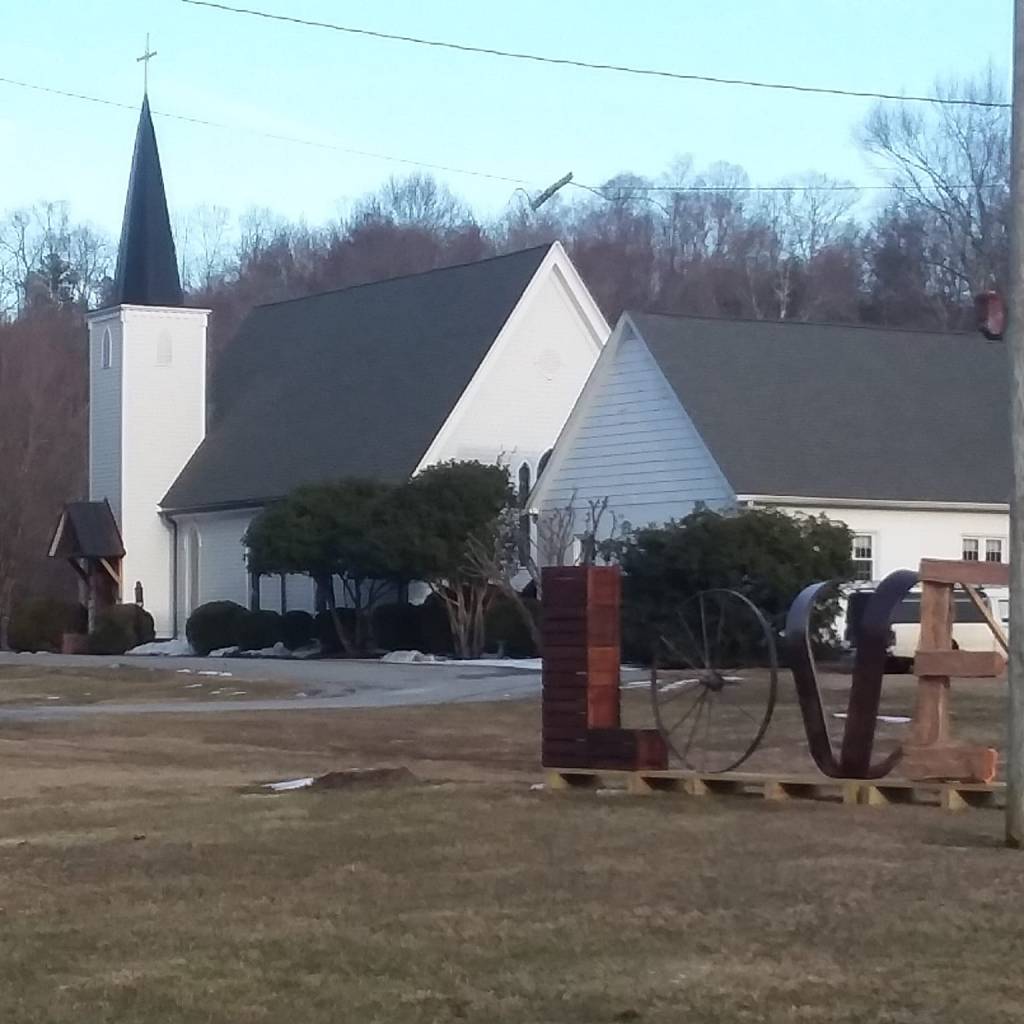
Special thanks to Sharon for the concept and Frank for the construction
Johnny Ponton and Ted Hughes, both of blessed memory, contributed materials and energy to this project.
As some of you may know, there has been a recent addition to the campus of Grace Episcopal Church in Massies Mill. If you happen to be driving down Crabtree Falls Highway toward the mountains, you’ll be greeted by an installation made up of apple crates, a tractor wheel, a bent fender, and some cedar wood. This collection of objects were all gathered up from farms and properties within Nelson County, and they have been brought together by skilled hands and creative minds to spell out a word- L-O-V-E. This sign has been an ongoing project and there are still adjustments being made to help it stand out even more and draw the eyes of all who pass by Grace. Soon, the LOVE sign will be registered and added to the list of over 300 such signs all over the commonwealth, and added to a map that allows travelers to visit us and add a photo of our sign to their collection. The story of each sign is as different as the materials and people that created it, and ours is no exception. The familiar “Virginia is for lovers” slogan may come to mind for many as they pass our sign, but the choice to add ourselves to the long list of sign sites is less about red-heart romantic love and more about who we are as a church.
Love has become, in many ways, a catch-all. We say “I love you” to pets, family members, friends, and romantic partners. When we are being most inclusive, we reference someone’s loved ones to mean everyone dear to them, not just their kin. We say we love our favorite things, our favorite foods and hobbies and places. We say Love your Neighbor and that God is love. We hear about love from pulpits and on TV shows and in feel-good human interest stories. In the church we sometimes oversaturate our language and our teaching with the word Love to a point that it loses all its meaning. Here in Virginia, the commonwealth that claims the slogan “Virginia is for lovers,” Love has quite literally become a brand, a marketing angle. Our own denomination has created an entire curriculum around the Way of Love, and our presiding bishop is well known for his favorite phrase- “If it’s not about Love, it’s not about God.” For many of us here, love is the central value around which we strive to build our lives, the way we relate to the world when we are our best selves. Love is so much a part of our language, our culture, our scripture, and our relationships that we run the risk of forgetting to look closely at what that really means.
When Jesus gives this sermon to his people, he is not warning them about devils or demons. Jesus is acknowledging the painful truth that not all people and not all systems act from a place of love. There will be enemies of the faithful, there will be haters and people who picket and spew curses and make horrible signs and write despicable things about those who choose to follow Jesus. There will be those who abuse the vulnerable, for their faith or for their differences or for no discernable reason at all. This passage has been used time and time again to silence victims of abuse, to discourage the work of justice by the oppressed and the marginalized, to prioritize the comfort of the many over the needs of the few. I want you to hear me say that this is not one of those sermons. That is not what love looks like. The imperative to pray for your abusers is not the same as tolerating abuse. The Biblical imperative to love and forgive your enemies does not require you to stay in relationship with them. In fact, the image of God imprinted upon your very being demands your safety, it demands that your voice be heard and that your body be protected and your abusers held accountable for their actions, whether the abuse be interpersonal or systemic. It is no less than Gospel work to end cycles of abuse and to hold in tenderness the survivors as they heal. That is what love looks like.
The word that Jesus uses in this sermon on love is not philia, the Greek word for brotherly or familial love. Jesus is not commanding that we like our enemies. In fact, Jesus does not really emphasize liking one another all the time as an expectation of his disciples or of those who follow him. The wandering preacher collected a diverse community of wealthy and poor, politicians and religious elites and the disabled and the possessed and the elderly and the young. He does not seem to have entertained any notions about everyone getting along after his death, and we know from the writings of Paul and others that there was in fact plenty of disagreement and in-fighting and clashing of personalities. The love we’re talking about is not the love of approval or even the love of unconditional positive regard. Neither does Jesus use eros, the word for romantic love and physical attraction. In fact, Jesus very rarely addresses the love between romantic partners at all, and when he does it seems to be out of concern for how those partnerships affect the entire community and especially the socially vulnerable wives and children involved. So while many LOVE signs in Virginia include the iconic red and the cartoon heart, our sign is not a monument to that sort of love either. The word that Jesus uses when he commands us to love our enemies is agape, the wishing of good for another, the unconditional and unchanging love between God and creation. The love Jesus commands, the love that inspired our sign, is the love that allows us to see one another as God sees us, and to live out the dream God has for us. When Jesus says, love your enemies, he is saying see them as God does. See the world as God does. See what is possible, and live your life in a way that makes the possible real.
The enemies, the haters, the ones who curse, the abusers, the ones who strike out and the ones who take away; these are all images of a life lived without eyes of love. Jesus offers the alternative, the commandment to love, to do good, to bless, to pray, to give and give generously, to forgive debts and to withhold judgment and condemnation. This is what love looks like. Not a world where we all get along with no conflict or disagreement, not an emotion that makes us feel nice but is fleeting and ebbs and flows throughout a lifetime. Not a world of silent acceptance of abuse or injustice, and not a church where everyone likes everyone and we’re all of one mind on all matters. Love looks like living out the life of Jesus regardless of what others think of us. Love looks like holding ourselves and one another and the world around us accountable to a peace that is the outcome of justice. Love looks like solidarity with the abused and with the vulnerable and with the unlikeable and the irritating. Love looks like creating sanctuary for those fleeing violence and oppression. Love looks like choosing accountability over retribution. Love looks like standing in the cold without a jacket because you’ve given all yours away, and a fellow disciple wrapping you up in theirs. Erecting a 6 foot tall sign between our church and the world invites us to always look at the world through that lens of love, and invites the world to hold us accountable to who we claim to be. The same has always been true of calling ourselves Christians, and marking our spaces and our bodies with the sign of the cross. We are people who have been created, redeemed, and sustained by Love. We ourselves are embodied signs of God’s unfailing love for all creation, God’s hands and feet and hearts and voices in a world that has forgotten what love looks like. May all who pass us by see and know that this is what Love lives like.
 Mother A Writes
I love this sermon…this is my favorite, so far In my opinion, it speaks perfectly to our needs and responsibilities and is so very timely.
LikeLike