John 20:19-31
There is a story, a bit of a parable, that is attributed to the Irish. A man dies, and when he arrives at the gates of heaven, he asks to be let in. St Peter is more than ready to open the gates to him, but first he says “Show me your scars.” The man is confused and tells St Peter that he has no scars. St Peter responds, “What a pity. Was there nothing worth fighting for?”1
On the same day that Jesus rose from the grave and appeared to Mary Magdelene in the garden, he appeared also to the men. Unlike Mary, who came looking, the men were afraid, and they hid behind a locked door. These disciples were known to be associated with the recently executed prophet, and they had good reason to fear. The leaders of the synagogues and the Sanhedrin did not approve of the actions and teachings of Jesus, and anyone caught repeating them did so at great risk. The Roman government seemed hellbent on eradicating Jesus’s message of a different kind of kingdom, and this oppressive regime killed people for much less. Most of the disciples were far from home, far from their families of origin and the livelihoods they had left behind to follow Jesus, so their resources were limited. So they hid, and grieved, and waited for the other shoe to drop.
But Jesus showed up in that place of fear and grief and foreboding, scars and all. He showed up and offered them peace, his own presence the sign of that peace that passes all understanding. He immediately showed them the scars in his hands where the nails had been driven to hang him on the cross, and the wound in his side where the Roman soldier pierced him with a spear. He did not need to be asked. The disciples did not ask for proof that he was who he claimed to be; that proof was freely offered from the start. It was the combination of the familiar words of peace and the sight of those scars, the proof that their heartbreak had not been based on falsehoods, that breaks the shock. They rejoice to see him, truly see him, and embrace him and receive every word and breath he utters for the miracles that they are.
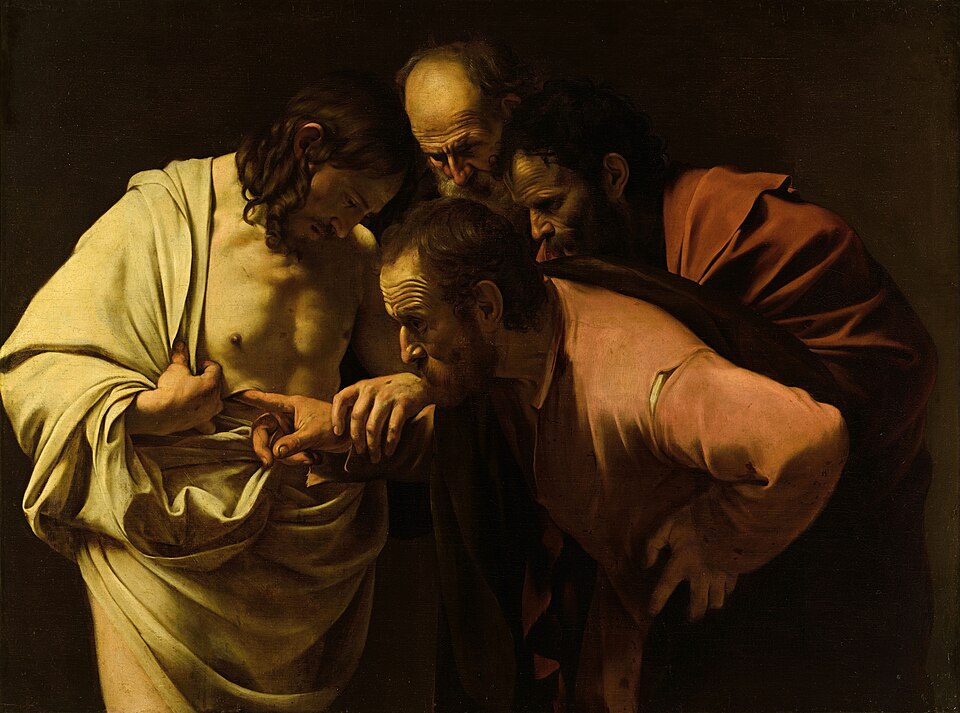
But someone was missing. Thomas was not there. We don’t know why. Perhaps he was out running an errand for the group. Perhaps he was staying with family or being hidden by another follower of Jesus someplace else in the city. Maybe he was at the market or maybe he had gone to the Temple to pray. Maybe he just needed to clear his head, so he went for a walk. For whatever reason, he was not there, and he missed Jesus. He missed the moment of revelation, when Jesus revealed himself fully alive after having been fully dead. What his friends tell him seems like a dirty trick, a cruel joke, a twist of the knife already piercing his heart. So he swears. He says no. “Unless I see the mark of the nails in his hands and put my finger in the mark of the nails and my hand in his side, I will not believe.” Until I have seen and felt what you claim to have seen and felt, I will not believe. Who can really blame him?
Again, Jesus shows up. Again, he offers up his hands, his side. Thomas greets him with a radical confession. “My Lord and my God!” Even still, after everything, the disciples did not fully understand who Jesus was. But in that moment, Thomas got it right. He saw the wounded flesh, the body that had been pierced and broken, the life laid down for him, and called it what it was. My Lord and my God. Our Lord and our God.
The wounds of Jesus, his scars, are a hard reality to face. Many churches have moved away from hanging crucifixes, preferring the more symbolic empty cross to the macabre body crowned with thorns. Much of the favored artistic representations of Jesus conveniently omit the scars, or else make them tidy and unobtrusive, wounds long healed. But historically, people of faith have loved those wounds. Whole portfolios of art, whole books of poetry and prose, entire lives have been spent depicting and reflecting on the meaning and the depth of those wounds. The holes made by the nails in Jesus’ hands and feet. The slash in his side from the tip of Empire’s spear. Mystics have dreamt of them, saints have manifested them on their own bodies, the Gospel writers remembered and recorded them. And every year, no matter what, on the Sunday after Easter we read about them. We hear again the story of Thomas, of his doubts and his ability to be in the wrong place at the right time.
Why do the wounds matter? Why should we care that Jesus still has them in his resurrected body? Surely all that matters is that he is alive, and risen indeed. Right?
“Show me your scars” St Peter says. “I have no scars” the man replies.
“What a pity. Was there nothing worth fighting for?”
When Jesus appears to his loved ones on the third day and in the days to follow, he appears wounded and scarred. When he embraces Mary, he does it with a gash in his side. When he bids peace be with his disciples, he does so with hands raised, daylight streaming through a hole in each one. When he ascends into heaven, to take his place at the right hand of the Father, he does so with scars. He has scars because he believed we were worth fighting for.
This is the Good News of nail holes and gashes. This is the Gospel, bruised and bloodied and still whole and alive. The God who created everything, the entire universe and every cell of our bodies, loves us so much he was willing to fight death itself to save us. Our Lord and our God knew, even hanging from the cross, that the people who put him there were worth fighting for, worth dying for, worth coming back for. Our God believes that we are worth fighting for, and our God always will. He has the scars to prove it.
- To the best of my researching ability, there is not a specific author or originator to whom I can attribute this story. I was inspired to include it by this threads post and it turns out there was a very similar exchange on a recent episode of the show Shrinking (which I have not seen). Otherwise, the most notable attribution I could find was a speech given by Martin Sheen while accepting an award at Notre Dame University ↩︎
 Mother A Writes