Acts 17:22-31
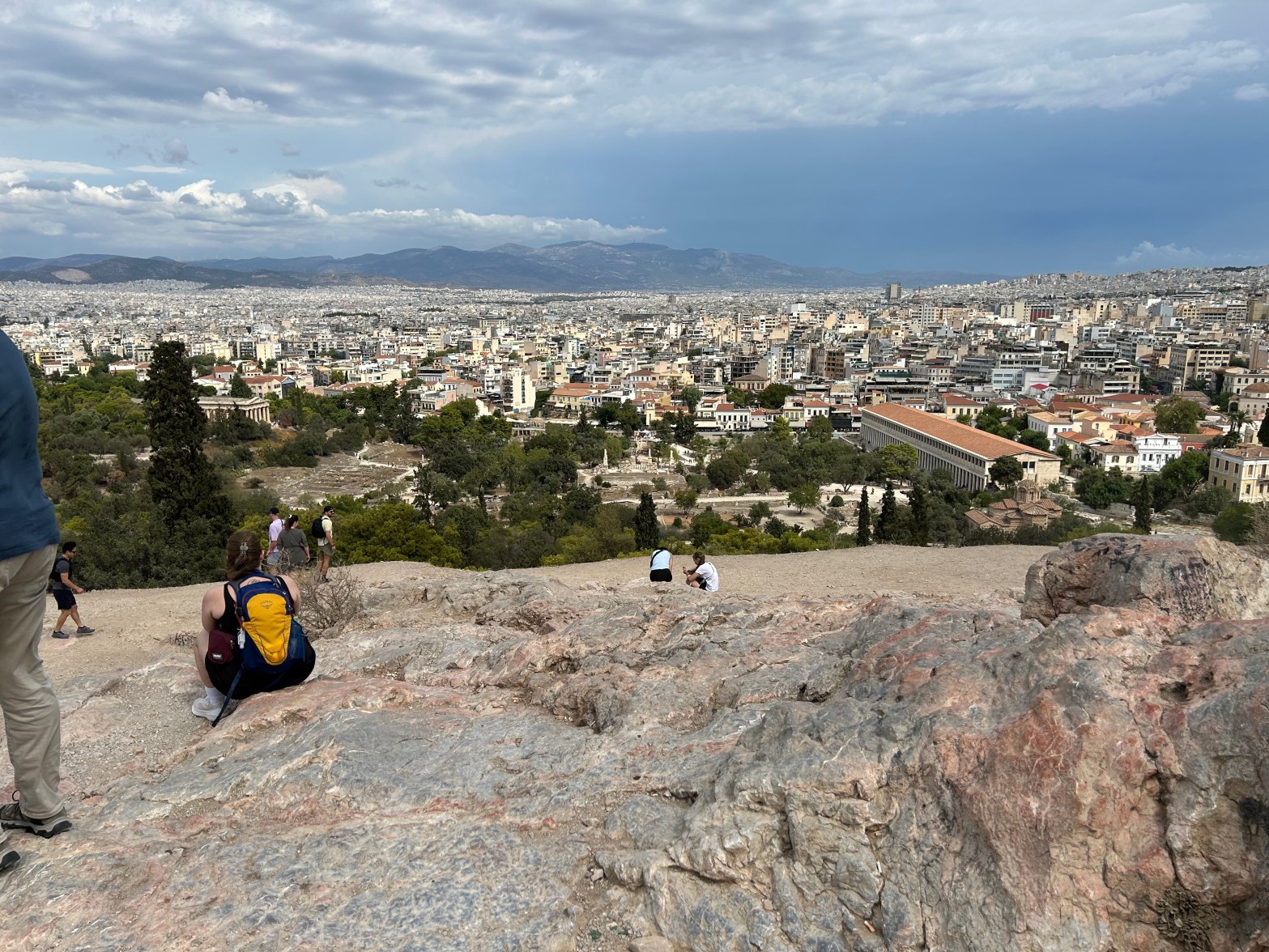
A few years ago, as many of you know, I had the great privilege of embarking on a pilgrimage to follow the footsteps of Paul through Greece and Turkey. As part of that journey, we spent some time in Athens, a city that looms large in history and our imaginations but was in fact a rather small city when Paul arrived there. Although my experience of Athens was a sprawling Mediterranean city dotted in every direction with thousand year old Orthodox Churches, in Paul’s day it was filled with religion of a very different kind. The city was full of idols, with shrines on every corner and in every home of means. Of course the Parthenon, the famous shrine to Athena, towered over the city and commanded the attention of worshippers and pilgrims from all over the Greco-Roman world. One can imagine a Jew who grew up in a religion that forbade graven images and statues would be a bit overwhelmed by Athens, and might have trouble connecting with the people there.
This sermon of Paul’s is one of his lesser known, lacking the powerful prose of his letter to the Romans or the poetic definition of love in his letter to the Corinthians. It is brief, and one of very few recorded in Acts where he is not immediately jailed or run out of town after completing it. The verses that follow our passage today tell us that some scoffed at the notion of the resurrection of the dead, but others were intrigued and eventually became believers. Athens would not become a majority Christian city until well after Paul’s death, but the seeds he planted there have shown it to be good soil.
The incredible thing about this mostly overlooked sermon is that it is the very definition of Paul’s evangelistic approach. Perhaps more succinctly than anywhere else in his speeches or his writings, Paul reveals the true mission that has gotten lost in the centuries of conquering, colonizing, and converting that have led so many to cringe at the word evangelism. Paul teaches us here exactly what it means to be an evangelist, a witness, a bearer of good news. If we follow in his footsteps, we might see the growth we desire for our church family and spread the hope that our world so desperately needs.
When Paul arrived in Athens, as he did everywhere he went, he started with his own people. He found the synagogue and talked with his fellow Jews about the meaning of Jesus’s life and the truth of his death and resurrection. After spending time in the Jewish community, and usually after many of them offered to show him the door, Paul moved on to the gentile community. In Athens, we know he spent a good deal of time in the marketplace and the agora, where much of civic life took place. He argued and debated with Epicureans and Stoics, and really anyone who was willing to talk with him. As the author of Acts puts it, the Athenians and the foreigners living there would spend their time in nothing but telling or hearing something new. In other words, they loved gossip, and Paul was the talk of the town. He caused such a stir, and the Athenian people were such a curious and philosophical bunch, that they invited him to the Areopagus to make his case and engage in further debate. And here is where Paul laid out for us what the mission of an evangelist really is.
Paul’s address to the Athenians is respectful, and truthful. He has observed their ways, he has wandered their streets and talked with their people. He has even entered some of their shrines and temples to look carefully at the objects they worship and the inscriptions in the marble and stone of their altars. He has remained curious, even as he was initially distressed by the preponderance of idols. And in his curiosity, he has found a shrine dedicated to an unknown, unnamed god. What good news he has to bring them, that the unknown god to whom they pray is the God who has been made known in the life of Jesus of Nazareth, whom death could not hold. Paul sees in the Athenians with their idols and altars the same desire, the same grasping for God that he has always known in his own heart. This is a people who have encountered God, and have tried to give God a name and a face and a home in their midst. Paul offers them a new vocabulary, a new language to understand and talk about the God that they are searching for.
Paul does not come into Athens and start smashing idols and protesting outside of the Parthenon. He does not call the Athenians godless or heretical or barbarians in need of conversion. He tells them they are offspring of the same God that made him, that God is close to them, and indeed is already in their midst. He quotes their own poets, and points to their own religious practices as a gateway into a new way of being with God. Paul sees the people to whom he brings the good news of Jesus Christ, and understands that he does not bring God to them. To be an evangelist is to be a bringer of good news, not a bringer of God, because God is already present and working in all places and among all peoples. This is the mistake so many of us have made over the centuries, and so many Christians continue to make today. We have forgotten what Paul taught us by word and example.
We know that we do not want to be Bible thumpers, and we are not in the business of counting how many souls we can save with a prayer. But we live in a world with just as many idols and false gods as the Ancient Athenians. We are surrounded at all times by people who search for an unknown god, and in their groping they find plenty to cling to; celebrities, politicians, harmful drugs and alcohol, wealth, youth, weapons, work that never stops. They are God’s beloved offspring, and most of them have never heard that before, at least not from someone who really meant it. They have never been told that God is near to them without a threat underlying the statement. They have never heard the truth that death has no claim over them, and so neither do the death-dealing powers of this world. They have heard of God the judge, but never that the one who will judge us has already redeemed us and loves us beyond measure.
Paul did what he did, enduring beatings and imprisonments and rejection and isolation, because he felt compelled to ensure that people like the Athenians had heard about the God who loved them enough to die for them, and then to come back and live for them. He was so full of desperate love for these people, almost all of them complete strangers to him, that he could not stand to let them go another day without knowing that the God who made them would never leave them behind. Not to collect converts, or even to plant a church. Paul did this simply because he felt he owed it to God’s people to tell them all that God had done and was still doing for them. He did not do it perfectly, and he was only one example of the many whom Jesus sent forth in those early days. But his example has been handed down to us for a reason.
Perhaps most of us are not called to stand up in marketplaces and streetcorners to preach the good news and debate with passersby. But every one of us has the capacity to see how God is working in the life of someone who doesn’t have the words to describe it. Every one of us can listen and share the love that God has put in our hearts for our fellow pilgrims, even the ones we don’t yet know. Every one of us can name the God in whom we live and move and have our being, and the ways we encounter that God in the world. Every one of us has the capacity to be an evangelist, and our mission is clear. Tell someone that the love they are searching for has already found them. In the name of Jesus. Amen.
 Mother A Writes