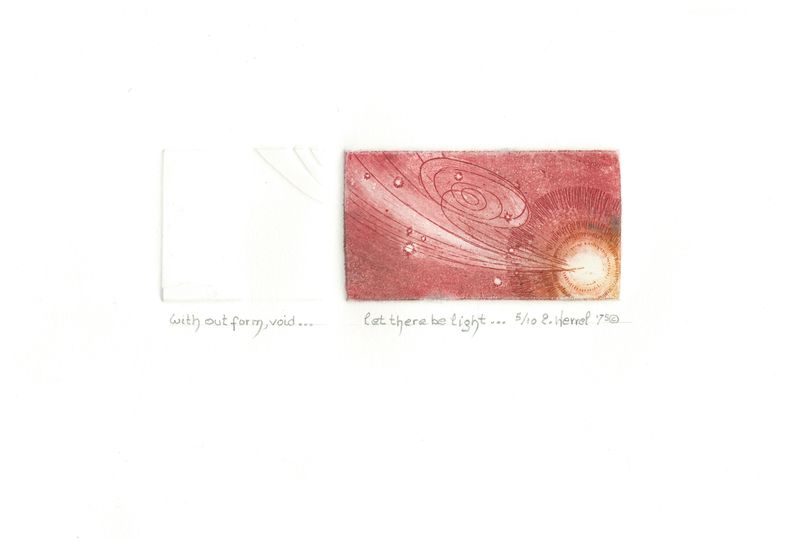
Genesis 1:1-2:4a
As I was tending to the overgrown mess my garden has become in the aftermath of all this rain and the months I have not been able to care for it as I usually would, I was thinking about Genesis 1 and 2. As my hands held tender seedlings and robust cuttings, I thought about the hands that first formed their ancestors. As I lifted up planters and disturbed hundreds of tiny insects and the occasional snail, I thought about the God who thought to include creeping crawling things in the tapestry of creation. And as I pulled out the weed whacker to clear a path through nonnative grasses and invasive creeping Jenny and colonizing English ivy, I thought about the kind of dominion God intended for us when he created our predecessors, the first humans to walk upright and unarmed through creation.
For a long time, humanity has conveniently forgotten that intention. We have interpreted dominion as domination, ownership, conquest. While some cultures and communities remembered and maintained the symbiosis possible between humanity and nonhuman creatures, others chose to forget. The dominant culture that invaded and colonized this and many lands through violence, including violent and oppressive religion, did not see itself as codependent with the rest of creation, and we have been reaping the consequences for generations. One of the most heartbreaking realizations is that we will never know fully what we have lost. We will never know the names of the wildflowers that only existed in very specific places, perfectly formed for their unique environment, because they are extinct and so are the languages and some of the peoples who knew their stories. We will never know fully what medicines we have destroyed or bred out of usefulness, what cures to devastating diseases we will never discover because the key was hidden in a tiny creature too easily trod underfoot by careless conquerors. I cannot imagine this is what God had in mind when God tenderly shaped the first gardeners, the first shepherds and fishermen, and asked them to join in the act of creation.
This is why it is so important that we return again and again to Genesis, to the beginning. In our postmodern post enlightenment age, many believe that humanity has outgrown the myths and stories that have been handed down to us. We might think the creation story is nice for kids, they like hearing about the animals of course. But we adults know that science has disproven this bedtime story, right? We know that the earth was not created in six 24 hour days, and we know that there were a few thousand generations between the first sea creature and the first creeping crawling thing. We know that at one time the Appalachian mountains and the Scottish highlands were one connected mountain range, because we know that the land and the sea have changed over millennia. We know that at various points in earth’s history the land we stand on now was at the bottom of the sea, and that magnolia trees have such strange flowers because they evolved before there were bees or butterflies to pollinate them. So with all this knowledge, and with the means to continually discover more, what good is a repetitive poem that is so clearly out of date?
Unfortunately, friends, it is that kind of thinking that got us into this mess. The men who sought to claim this land as if it were empty thought they knew more, understood more, were in fact more human than the ancient civilizations that tried to introduce them to the land and its inhabitants. The men who clearcut the old growth forests and pierced the earth for coal thought themselves above what they believed to be primitive understandings by the indigenous peoples who managed the land and water with care instead of extraction. The men who nearly drove the bison to extinction for money and the sport of it, goaded by rewards from a government that wanted to see the peoples who coexisted with the bison go extinct with them, had no interest in understanding how the peoples of the plains maintained a delicate balance. It is only through the steadfast faithfulness and refusal to forget that some tribes have kept this knowledge alive and are still fighting to restore what has been lost. We ignore our own ancient knowledge, passed down to us through stories, at our peril.
To the skies, God gave the task of separating light from dark, day from night, earth from space. To the stars, God gave the task of marking seasons and signs, a map in the sky to navigate both time and space. To the plants and the trees God gave the task of bearing fruit and seed, replenishing and nourishing the creatures of the earth. To the creatures of the land and of the sea, God gave the task of filling their domains, being fruitful and multiplying, recreation. To us, to humankind, God gives many of these same tasks. But to us there is another charge given, something that is different because we as image bearers are different, distinct from our fellow creatures.
This is where we get tripped up. This is where we veer off into supremacy and exceptionalism and domination. At no point does God say that humanity is more important than the other creatures. In fact, humanity is the youngest, the last born, a detail that would have meant a lot to the culture that first told this story. In a society that was predicated on the firstborn male being the sole heir and head of a family, for the first man and woman to be created last of all is significant. As the youngest, they are at the mercy of all that came before them.
And isn’t that still true? Isn’t that wisdom? The capitalist food system has convinced millions of people all over the world that food is something that is produced by humans, but it is the trees and the plants that produce the fruit, the grain, the leaves and roots. If all the plants on the earth decided to go on strike at once, we would be very quickly reminded how dependent we are on green growing things and the people who tend them.
God tells humankind to be fruitful and multiply like all the other creatures, to populate the earth and subdue it. God tells humankind to have dominion over all the living creatures of every kind, and then shows them how plentiful the food will be from the plants. Notice that at this point in the creation story, all living things appear to be vegetarian, as God has given all creatures green plants for food. The kind of dominion God intends is not then a violent domination of one species over all others, a hierarchy based solely on how all the constituents benefit the beings at the top. God invites a dominion of abundance, inspired by the fruitfulness of trees and wild animals. Not the oppression of kings and emperors but the dominion of farmers and shepherds. A mutual dependence, a shared knowing. The kind of understanding that exists between a gardener and the plants they tend, when no amount of insistence on the part of the gardener will persuade a plant to grow where they do not want to. This is the kind of knowledge that can become lost to us, when we leave our stories behind. It is our responsibility, our sacred duty, to revisit and remember the stories of our ancestors, because they are our stories too. As new challenges, new discoveries, and new opportunities to exercise either dominion or domination arise every day, as humanity learns more about ourselves and the world around us, we need these stories and their lessons more than ever. So let us tell our stories, and remember.
 Mother A Writes