Matthew 14:22-33
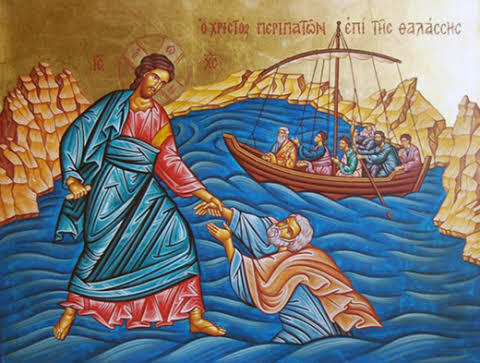
I have in my office an icon of this scene from Matthew’s Gospel. It depicts Peter’s fear, the water up to his waist, Jesus standing on the surface and reaching down to pull him from the waves. In Greek, the words of Peter run along the top of the icon: Lord, save me. And on the bottom of the icon are the words Jesus spoke to Peter: You of little faith, why did you doubt?
I found this icon in a traditional Greek Orthodox iconography shop in Greece during my pilgrimage a few years ago. It was small and off to one side, overshadowed by the massive icons of Jesus and Mary and Paul and the various influential saints of Greek history. I had never seen an icon of this particular scene, so I didn’t even think to look for it, but it caught my eye anyway. I was so grateful that it did, because my pilgrimage companion was moved to tears when I showed it to her. Linda, who made my participation in the pilgrimage possible, is my late best friend’s mother. Melissa, who we lost almost six years ago at the age of thirty, had always felt a special kinship to the Apostle Peter. She identified with this story in particular, with Peter’s daring leap from the boat and his fear that threatened to overwhelm him. She even had tattooed the words of Jesus into her skin, “You of little faith, why did you doubt?”, translated from the Greek into Aramaic, the language of Jesus’s upbringing. We knew about the tattoo, but no one could make out what it said, and after she died many of us felt desperate to solve the puzzle, to get an answer when so many questions were left unanswered by her death. Finally, we found a scholar who could translate it for us, and only a few weeks later in that little shop in Greece we came across an image of the exact moment our loved one had held so dear. We each bought a copy, and I have kept it in a place of honor ever since.
I know some of the reasons why my friend was so moved by this story from the Gospel of Matthew. I know that there are many others who find solace, strength, and even challenge in the scene. But it has taken me a while to find my own way into the story, to see where I might fit into one of the most famous moments in the life of Jesus.
I find that often, the sermons and commentaries about this story focus on Peter’s doubt as if it were a moment of weakness, a failing that is only overcome by the generosity of Jesus. We read Jesus’s question to Peter as an admonishment, the doubt a cutting indictment against Peter’s supposed faith. But for the first time, I have noticed something I have managed to blow right past for years. Something I think matters very much for how we read this story, and where we find ourselves in it. And maybe more importantly, it matters where we find Jesus.
The moment when Peter starts to sink is identified by many as the moment of doubt to which Jesus refers. If he had only believed, he would not have become frightened, and his feet would never have broken the surface of the storm-tossed sea. But that is not the moment when Peter begins to doubt. What we see in this story is not a leap of faith ruined by doubt’s presence. What Peter and Jesus show us is how doubt and faith coexist, and what God can do with even the tiniest seed of faith, even as it seems to drown in doubt.
If we take a moment to zoom out, to time travel a bit back to the very beginning of Jesus’s earthly ministry, we find Jesus in the wilderness enduring the temptations of the Adversary. The first test is a foreshadowing of last week’s miracle; Satan commands a starving Jesus to transform stones into loaves of bread. Although Jesus resisted the temptation to manipulate creation for his own gain, he gladly multiplied the loaves and fishes for the sake of others. The second test is where we find our clue about today’s lesson, the passage that fundamentally transforms how we read this one. Satan transports Jesus to the top of the Temple, a great height, and challenges him to throw himself from it. Surely, Satan reasons, God the Father will not allow his beloved son to fall and will send angels to save and protect him. Again, Jesus resists the temptation. His reasoning? “Do not put the Lord your God to the test.”
It is the testing that indicates doubt. It is making a demand of God and then blaming God when our demand is not met that indicates our faith might be little or at least misplaced. When Jesus said to his disciples in the boat where they cowered in fear, “Take heart, it is I; do not be afraid,” Peter answered him by issuing a challenge. “Lord, IF it is you, command me to come to you on the water.
Before Peter ever stepped out of that boat, he had expressed doubt. He had set a test for Jesus, unwilling to take him at his word. Still, harboring his doubts, Peter leapt from the boat and began to walk on water toward Jesus. In the middle of the tempest, he became frightened, and like any lifeguard can tell you, panicking people sink like stones. Immediately, Jesus reached out and caught him by the hand. We are told they got into the boat together, but not how they got there. We can guess that either Peter succeeded in walking on water with his hand still clasping the Lord’s, or else Jesus carried him across the waves. In either case, Jesus passes the test he himself chose never to demand. Jesus once again meets doubt with faithfulness, fear with constancy, and challenge with love. The faith, or lack thereof, of Peter does not change his course. He walks across the water to his disciples, and climbs into the boat to be near them. There is no gloating, no showing off. Jesus does not replicate the miracle like a party trick to impress the crowds. He walks across the water because that is where his friends were, and Jesus does whatever it takes to reach them, no matter where they might be or how he might be received.
Peter’s doubt does not negate his faith, and neither his faith nor his doubt changes Jesus. He is who he says he is, even when no one, not even his closest friend, understands or believes in him. Jesus is faithful even when we are unable or unwilling to be. Jesus is truthful even when we don’t believe or don’t want to hear it. Jesus is the Son of God, no matter how we might feel about it in any given moment. And that remains true whether we stay in the boat, terrified, or leap headlong into the waters. It remains true whether we walk across the surface or find ourselves barely keeping our heads above water, gasping for air and crying out for someone, anyone to help. Peter doubted, and still he took that first step. Peter nearly succumbed to fear, and still he cried out, trusting that Jesus could save him. The other disciples never stepped foot outside the boat, and still they witnessed love overcoming fear and doubt.
What this scripture teaches us is that showing up is enough. Being in the boat is enough, when that is all we have in us. Being afraid, but present, we might witness miracles. Being doubtful, but stepping out in faith anyway, is enough even when our resolve crumbles. Being willing to call out for help, to reach for Jesus when the waves threaten to overwhelm us, is how we survive the storm. Our little faith is not a hinderance; we have seen what God can do with our most miniscule and insufficient offerings. Our doubt does not change who God is, but the tiniest flicker of faith can change who we are and what we are capable of becoming. The life of faith is an ever-expanding spiral of belief and unbelief, faith and doubt, hope and despair. But the direction is always the same, spiraling ever closer to the reality of Love Divine. So have a little faith. Because with God, a little is more than enough.
 Mother A Writes