Matthew 15: (10-20), 21-28
Jesus begins our narrative this morning by offending a group of Pharisees, after which he doubles down and expands on the message that first triggered controversy. Shortly after, and somehow in an entirely different place, now in Gentile territory, Jesus dismisses a woman who has come to him for aid. When she does not let up, Jesus doubles down, insulting her in the process. Still she does not submit, challenging this man she does not know to deny the most basic tenets of hospitality shared by both their cultures. She and her daughter may be on the bottom of the food chain, but they must still be fed.
The two stories can be read as entirely separate incidents that happen to land next to each other in the narrative, but I think Matthew deserves a little more credit than that. The Gospel according to Matthew is laid out very carefully, filled with parallels and reprisals and foreshadowing. Matthew depicts Jesus as a man with a sense of humor, as someone who appreciates a metaphor, as someone who is constantly teaching through word and action. So when Jesus tells the crowds that it is not what goes into a person that defiles, but what comes out of their mouth, and then he turns around and says something offensive to a stranger in public, we can safely assume it wasn’t an accident.
What Jesus said to offend the Pharisees on this particular occasion is this: “It is not what goes into the mouth that defiles a person, but it is what comes out of the mouth that defiles.” The Pharisees struggle with this, but they aren’t alone. When Jesus says that it is not what goes into a person but what comes from their heart that matters, he is turning the moral world on its head. When he says that what comes out of the mouth proceeds from the heart, and out of the heart comes all kinds of evil things, he rejects the belief that human beings are defined by what we do. He names with clarity the harsh reality, that humanity is capable of evil, of murder and adultery and sexual violence, of theft and dishonesty that causes deep harm. But it is to the heart that he points as the source of purity or impurity, of righteousness or defilement. It is not what we do that defines us. It is who we are, and who God is calling us to be, that defines us. Everything else, to borrow Jesus’s somewhat crass metaphor, is waste.
So Jesus tells the crowd, including his own disciples and a group of Pharisees, that who they are is not defined by ritual actions or theological debates or the foods they eat. He does not reject the mosaic dietary laws; Jesus is never depicted eating bacon, nor does he go as far as Paul in crossing religious and ethnic boundaries to consider eating food sacrificed to idols. What he cautions against, what sometimes frustrates and even angers him, is the same concern that many prophets before him railed against. The practice of religion at the expense of righteousness is false religion. Becoming too focused on doing things the proper way can prevent us from seeing the neighbor in need. Becoming more and more insular and sectarian in our debates over theological minutiae can replace the kingdom work we are called to do, rendering our fasts and our sacrifices as waste.
Jesus did not only see this in the Pharisees who challenged him in public. More than once or twice, Jesus admonishes his own disciples for their lack of vision, for their inability to see the big picture. When they become too focused on who will hold authority over whom, when they try to bar the way to Jesus against people they deem unworthy, he corrects them with varying degrees of patience. Peter, always the one with his hand up to ask the first question, requests that Jesus explain the latest teaching to him and his fellow disciples. Exasperated by their inability or refusal to comprehend, Jesus repeats himself and expands on the message a bit, then moves on.
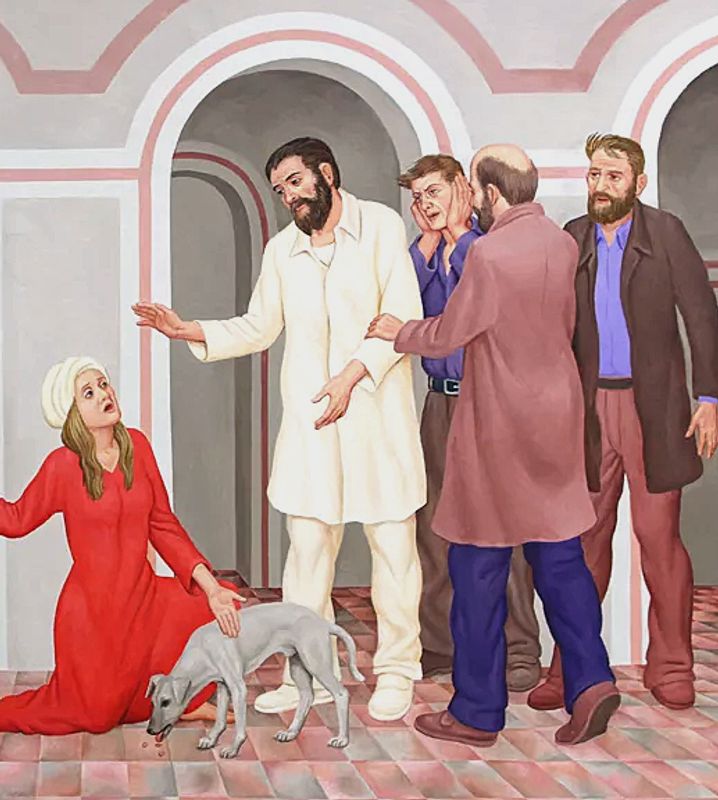
The scene that follows has been interpreted by some to be satirical, an object lesson for the disciples who have just finished missing the point yet again. The woman who comes to him is a gentile and a pagan, a member of the nation with whom the people of Israel clashed again and again upon entering the promised land. The disciples are bothered by the scene the woman is making, ignoring entirely the content of her supplication. Her daughter suffers, and as a mother it is her mission to relieve that suffering, even if it means pleading with a stranger from a rival nation. Jesus does not send her away, as the disciples urge him to. He restates his mission, and in the same moment he is confronted with another mission, another people in need of healing and salvation. And what does Jesus do? He calls her a dog, unworthy of what belongs to the lost sheep of Israel to whom he has been sent. And here we find the lesson, looking on with the disciples as they hear this exchange.
The disciples would have expected Jesus’s initial response, or something like it. This is not a person any of them would be comfortable making small talk with, let alone having a theological debate. The common insult may jar us, especially from the mouth of Jesus, but the disciples would have been unphased, embodying every assumption and prejudice with which they had all been raised. But if we recall the themes of Matthew’s storytelling, we might hear the tone of the following exchange a bit differently.
If we remember that Jesus is always teaching, if we remember the uncomprehending disciples from just a few verses before, we might start to hear a sarcastic, satirical note in Jesus’s voice. He says to this woman the words everyone expects him to say, but her response indicates that she received it not as a dismissal, but an invitation to dialogue. Something about the spark in his eye, or the conspiratorial twitch of a smile tugging at the corner of his mouth, emboldened her to push back. She takes his stereotyping and turns it around on him, calling out the hypocrisy that he so readily condemns in others. The metaphorical table that they find themselves on either side of, laden with plenty to go around, is salvation itself. Jesus has stated the long-held belief of his people; salvation belongs to the promised descendants of Abraham. The Canaanite woman has reminded him of the rest of the promise; salvation flows through them, and the blessings reach every nation.
Although Jesus is a Jew and the Canaanite woman is a gentile, there is enough overlap in culture that they would have the same understanding about both the real and metaphorical tables; everyone will ultimately be fed. There is an order, yes, a hierarchy that dictates who receives what portions at what time. The householders would eat before the servants, the free would eat before the enslaved, the honored guests would eat before the children of the house. But, as the woman points out, even the lowliest members of the community, the dogs and in many cases the people begging in the streets, would receive their portion too. In the end, as strange and uncomfortable as it may seem to our modern Western ears, this is a system in which all are fed in the end. It is only dishonorable, disgraceful households that do not allow the poor and the homeless to glean the corners and edges of their field and receive the excesses of their table. It is only the hard-hearted that would defile themselves by denying the stranger and the foreigner a seat at the table.
I hear laughter in Jesus’s proclamation of the woman’s great faith, and I don’t think its laughter brought on by surprise. Never knowing one another before this chance encounter, this determined mother has taught his disciples the lesson he had just finished trying to teach them. Her status as a gentile, a pagan, an outsider, a Canaanite should place her among the defiled by the Pharisees’ standards. She does not say the right prayers or make sacrifices in the Temple to the one God. She probably eats things that are forbidden in the Torah, and she has already crossed several boundaries just to have this conversation. And yet what has come from her heart is righteous, and true, and in this moment she helps to usher in an expansion of Jesus’s mission. He has come for the people of Israel; but not only them. He has sheep of other folds, flocks beyond the bounds of what his audiences might deem suitable. And they are lost, and hungry, and in need of Good News. This lesson was for his disciples, and for us too. There is no one beyond the reach of the kingdom; there is no one who will not be fed at Christ’s table.

